
How to Import from a China Steel Warehouse Supplier
The Engineering and Procurement Guide to Partnering with a China Steel Warehouse Supplier
Global construction economics have fundamentally changed. Developers, logistics operators, and industrial contractors can no longer absorb the volatile raw material costs and unpredictable lead times inherent in localized steel procurement. Relying on local fabrication often means subjecting your project timeline to limited workshop capacities, chronic shortages of certified welders, and heavy intermediary markups.
Procuring directly from a China steel warehouse supplier bypasses these bottlenecks. By accessing the world’s most concentrated hub of raw steel production and automated CNC fabrication, international buyers secure predictable pricing, engineered precision, and massive scalability.
However, the international supply chain is unforgiving to inexperienced buyers. The export market is saturated with trading companies posing as factories, leading to communication breakdowns and compromised engineering.
This guide provides the exact frameworks, technical benchmarks, and logistical strategies required to evaluate, select, and successfully import from a genuine steel warehouse manufacturer in China. The methodologies detailed here are based on decades of experience executing heavy industrial projects across Latin America, the Middle East, Africa, and Oceania.
Why More Buyers Choose Chinese Steel Warehouse Suppliers
The decision to shift procurement to China is rarely just about base price. It is about total project lifecycle costs and risk mitigation.
A local fabricator in Australia, Peru, or Kenya purchases steel profiles from a distributor who imported them from a mill. The local fabricator cuts and welds these manually. You pay for the distributor’s margin, the local labor rates, and the off-cut waste.
A top-tier Chinese industrial warehouse supplier purchases raw steel coils directly from domestic mills at baseline prices. The factory utilizes automated submerged arc welding (SAW) and CNC drilling to produce custom-engineered, built-up H-sections. You only pay for the net weight of the highly optimized steel frame. Furthermore, the entire structure is engineered for 100% bolted assembly on-site, eliminating the need for expensive, time-consuming local field welding.
Chinese Supplier vs Local Supplier Comparison
| Evaluation Metric | Local Fabricator | Direct China Steel Warehouse Supplier |
| Material Sourcing | Buys from distributors (high markup, limited sizes) | Buys direct from raw mills (lowest cost, unlimited profiles) |
| Engineering Capabilities | Often outsources detailing; basic 2D CAD | In-house 3D Tekla modeling; full dynamic load simulations |
| Fabrication Speed | 100–300 tons per month | 3,000 to 10,000+ tons per month |
| Material Waste | Buyer pays for off-cuts and standard beam waste | Zero waste. Tapered columns optimize weight perfectly |
| Site Assembly | Often requires manual cutting/welding on site | 100% pre-punched, pre-painted, bolted connections |
Key Factors When Selecting a Warehouse Supplier
Your project’s success hinges entirely on the entity you contract with. The primary risk global buyers face is accidentally contracting a trading company rather than a genuine factory.
Trading companies add a 10% to 20% margin, but more critically, they act as a dangerous firewall between you and the structural engineers. If a foundation anchor bolt layout needs a rapid adjustment, a trading company must translate that request to the actual factory, resulting in costly delays and technical misinterpretations.
Manufacturer vs Trading Company
| Verification Point | Genuine Steel Warehouse Factory | Trading Company |
| Business License | Explicitly states “Manufacturing”, “Production”, “Fabrication” | Lists only “Sales”, “Consulting”, “Import/Export” |
| Physical Location | Located in heavy industrial zones (e.g., Qingdao, Shandong) | Located in downtown commercial high-rise offices |
| Technical Meetings | Can immediately put a structural engineer on a video call | Relies on a salesperson to “check with the technical team later” |
| ISO Certificates | ISO 9001 registered to the manufacturing address | ISO registered to an office address, or entirely absent |
Large Factory vs Small Workshop
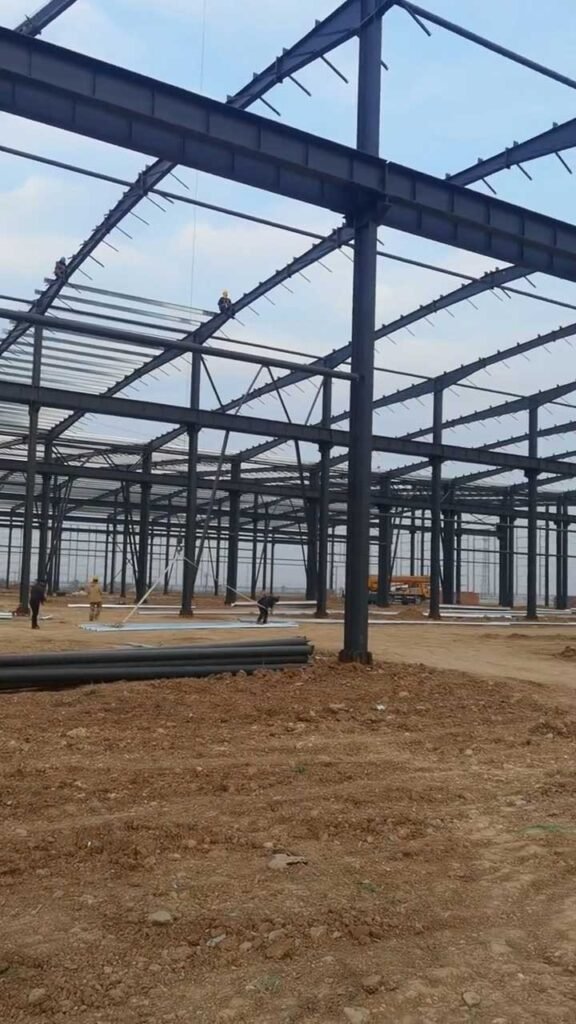
Even if you find a manufacturer, scale matters. A 20,000 square meter logistics center requires different throughput than a small agricultural shed.
| Feature | Large-Scale Manufacturer | Small Workshop |
| Raw Material Stock | Holds thousands of tons of Q355/Q235 steel in reserve | Buys material per order; vulnerable to sudden price spikes |
| Equipment | Multi-head CNC plasma cutters, automated shot-blasting | Manual cutting torches, wire-brush surface cleaning |
| Quality Control | Dedicated QA/QC lab; UT/PT non-destructive testing | Visual inspection only by the welders themselves |
| Container Loading | 3D simulated packing; dedicated heavy lifting zones | Haphazard packing; high risk of paint damage during loading |
Global Sourcing Comparisons
Buyers often weigh China against other regional manufacturing hubs. Here is the reality of the global steel fabrication market based on raw material access and automation.China vs Turkey Supplier
| Factor | China Steel Warehouse Supplier | Turkey Steel Supplier |
| Raw Material Source | Domestic (World’s largest steel producer) | Heavily reliant on imported scrap and billets |
| Production Scale | Massive automated lines; highly scalable | Good quality, but smaller overall workshop capacities |
| Logistics | Dominates global ocean freight lanes | Advantageous for Europe/MENA overland, expensive globally |
China vs Europe Supplier
| Factor | China Steel Warehouse Supplier | Europe Steel Supplier |
| Cost Profile | Highly competitive due to raw material and scale | Extremely high due to labor rates and energy costs |
| Code Compliance | Capable of CE (EN 1090) manufacturing | Native CE compliance |
| Customization Flexibility | High. Rapid re-tooling for OEM/custom profiles | Rigid. High premiums for non-standard structural requests |
China vs India Supplier
| Factor | China Steel Warehouse Supplier | India Steel Supplier |
| Detailing & Engineering | Standardized use of Tekla; high precision | Often relies on older detailing methods; variable precision |
| Fabrication Automation | Heavy investment in CNC and robotic welding | Higher reliance on manual labor and standard rolled sections |
| Export Infrastructure | Seamless port logistics and customs efficiency | Can face bureaucratic port delays and infrastructure bottlenecks |
Engineering & Structural Design
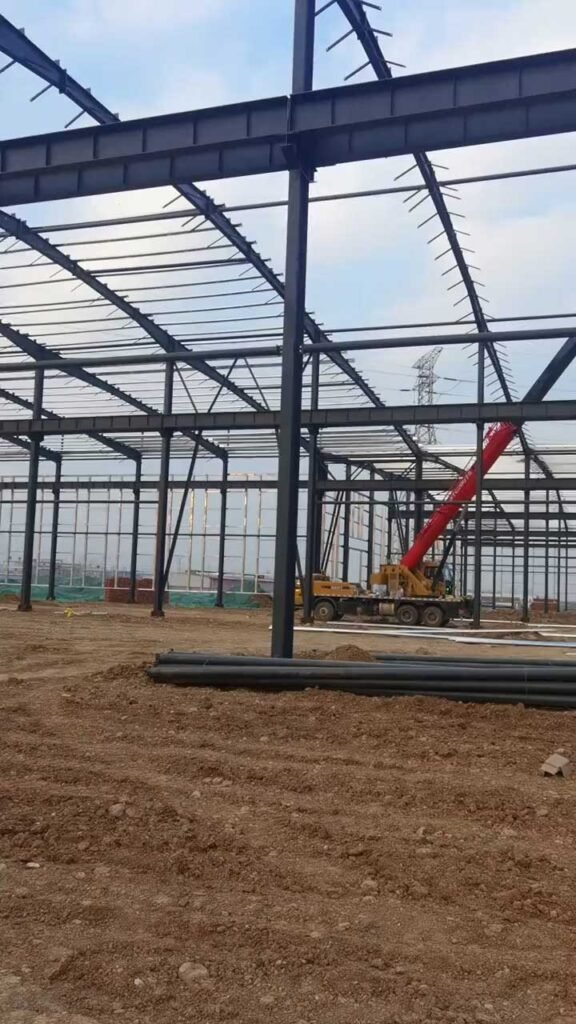
A prefabricated warehouse manufacturer does not sell off-the-shelf boxes. Every building is a custom-engineered solution responding to specific operational needs and environmental stressors.
When you engage our engineering team, we require your architectural concept, local climate data, and operational requirements. We utilize advanced software (Tekla Structures, PKPM, 3D3S) to generate a structural model that maximizes interior clear span while minimizing unnecessary steel weight.
Steel Material Standards: Q235 and Q355
Chinese structural steel grades are globally recognized and easily cross-referenced to international standards (ASTM, EN, AS/NZS).
Q355 (Yield Strength ≥ 355 MPa): This is the high-strength, low-alloy standard for primary structural frames (columns, roof rafters, crane beams). It is the equivalent of ASTM A572 Grade 50 or EN 10025 S355. Using Q355 allows our engineers to design slimmer, lighter built-up sections that maintain immense load-bearing capacity, directly reducing your freight and material costs.
Q235 (Yield Strength ≥ 235 MPa): Used for secondary framing (purlins, wall girts, bracing). It equates to ASTM A36 or EN 10025 S235. It provides excellent ductility and formability for components that do not bear the primary structural loads.
Designing for Environmental Loads
A warehouse steel building in the Caribbean requires vastly different engineering than a mining facility in the Chilean Andes. We engineer for precise regional variables:
Wind Load: For hurricane-prone regions (Central America, Caribbean, Southeast Asia), we simulate extreme wind pressures. This dictates the thickness of the column base plates, the density of the X-bracing in the walls and roof, and the gauge of the purlins to prevent roof panel uplift.
Snow Load: For projects in cold climates, roof pitch is critical. We calculate the dead load of accumulated snow to determine the exact spacing of roof purlins and the required web thickness of the main rafters to prevent structural deflection.
Earthquake Design: Seismic zones (Latin America, New Zealand) require structures that absorb ground acceleration rather than resisting it rigidly. We design high-ductility moment frames with specific beam-to-column bolted connections that can flex without catastrophic failure.
Advanced Structural Requirements
Large Span Warehouses: Logistics companies require maximum floor space without obstructive internal pillars. Using tapered, built-up H-sections, we routinely engineer clear spans of 30 to 50 meters, optimizing the interior for racking systems and forklift traffic.
Crane Systems: Heavy industrial investor projects often require overhead bridge cranes. We do not just add a beam; we engineer the entire building to withstand dynamic loads. We calculate the runway beams, crane brackets, and the specific column reinforcement required to handle the braking and lifting forces of 5-ton to 50-ton cranes.
Factory Manufacturing Capacity and Production Equipment
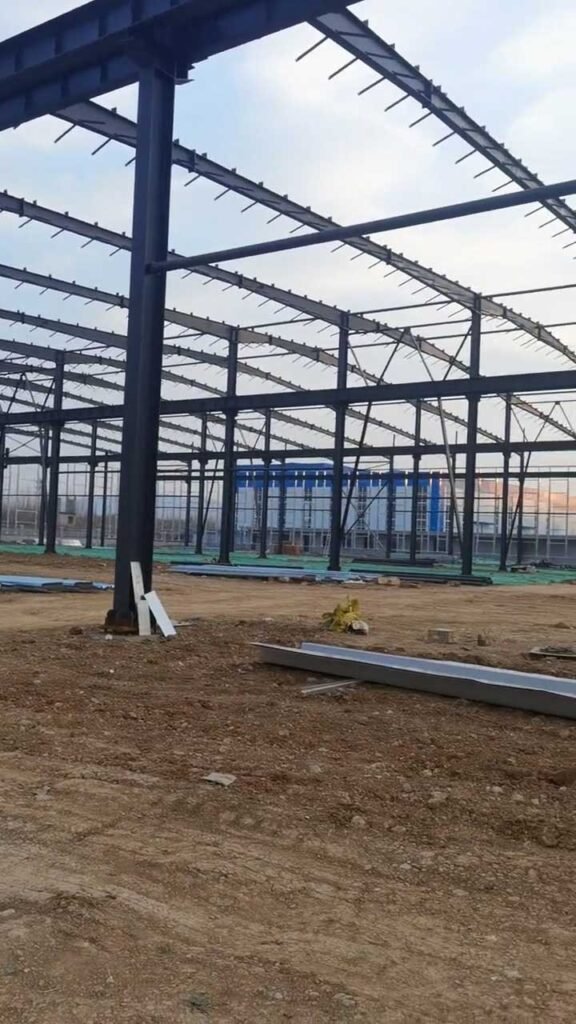
The ability to deliver a 10,000-ton project on time depends entirely on factory equipment. A true steel warehouse exporter operates an automated assembly line.
CNC Plasma Cutting: Raw steel plates are cut with exact precision. This ensures that web and flange plates fit together perfectly prior to welding.
H-Beam Assembly Machines: Plates are automatically aligned and tack-welded into the H-profile.
Gantry Submerged Arc Welding (SAW): This is the core of structural integrity. SAW provides a deep, continuous, defect-free weld penetration along the entire length of the column. Manual welding cannot achieve this consistency.
CNC Drilling Lines: Bolt holes are not drilled by hand. A 3D CAD file feeds coordinates directly to a multi-spindle CNC drill, ensuring that when the steel arrives on your site, every bolt aligns perfectly to the millimeter.
Flange Straightening: The heat from welding causes steel flanges to warp slightly. Hydraulic straightening machines apply immense pressure to return the beam to perfect dimensional tolerance.
Quality Control System and Welding Standards
Industrial contractors cannot afford to discover a structural defect when the steel is already hanging from a crane in Africa. Quality control must be aggressive and closed-loop at the factory level.
International Certifications
A reliable steel warehouse company must operate under recognized quality management systems.
ISO 9001: Demonstrates a tracked, repeatable manufacturing process. Every piece of steel is barcoded and traceable back to the original mill test certificate.
CE Marking (EN 1090): Crucial for the European market, this certification proves the factory’s Factory Production Control (FPC) meets strict EU safety and structural mandates.
CWB (Canadian Welding Bureau): For North America, CWB certification guarantees that the welding procedures and the welders themselves are tested to rigorous code standards.
SGS / Bureau Veritas (Third-Party Inspection): We welcome and regularly facilitate independent third-party inspections for global buyers who require neutral verification before container loading.
Non-Destructive Testing (NDT)
Visual inspection is insufficient for heavy industrial steel. We mandate:
Ultrasonic Testing (UT): Used on all full-penetration butt welds (e.g., splice plates, crane brackets) to detect internal voids, slag inclusions, or lack of fusion hidden beneath the surface.
Penetrant Testing (PT): Applied to critical fillet welds to reveal microscopic surface cracks before they can propagate under stress.
Surface Treatment: Galvanizing vs Painting
Corrosion dictates the lifespan of your warehouse. The choice between paint and galvanizing is an engineering decision based on your site’s proximity to the ocean, local humidity, and the building’s operational use.
Galvanized Steel vs Painted Steel
| Feature | Epoxy Painted Steel (Multi-Layer) | Hot-Dip Galvanized (HDG) Steel |
| Process | Sa2.5 shot blasting + Zinc-rich primer + Epoxy intermediate + Polyurethane finish | Submersion in 450°C molten zinc |
| Protection Mechanism | Barrier protection (seals steel from air/water) | Cathodic protection (zinc sacrifices itself for the steel) |
| Best Environment | Standard industrial zones, dry climates, interior structures | Highly corrosive areas, coastal zones, chemical plants, livestock |
| Cost | Baseline to Moderate (depends on micron thickness) | Higher initial investment, zero maintenance |
| Lifespan | 10 to 25 years (requires eventual touch-ups) | 50+ years in most environments |
Before any paint is applied, the steel must be aggressively cleaned. We utilize automated shot-blasting machines to propel steel grit at the columns, stripping away all mill scale and rust to achieve an Sa2.5 surface profile. This creates a microscopic texture that allows high-performance epoxy paints to adhere permanently.
Roof & Wall Systems (The Building Envelope)
The structural frame supports the building; the envelope protects your assets. We supply comprehensive cladding systems customized for your climate.
Thermal Insulation and Panels
Single Skin Corrugated Sheets: Suitable for basic storage in moderate climates where temperature control is not required.
Fiberglass / Rockwool Blanket Insulation: An economical solution combined with single skin sheets, providing excellent fire resistance and sound dampening.
Sandwich Panels: The premium solution for climate-controlled logistics, food processing, or regions with extreme heat (Middle East) or cold. We supply EPS, Rockwool, and Polyurethane (PU) panels. PU panels offer the highest thermal resistance (R-value) per inch, drastically reducing HVAC running costs.
Rainwater Drainage and Ventilation
In tropical regions like Latin America or Southeast Asia, intense monsoon rains require engineered drainage. We supply heavy-gauge galvanized gutters, large-diameter PVC or steel downpipes, and customized roof slopes to prevent water ponding. For natural temperature control, we integrate roof ridge ventilators and louvers, allowing hot air to escape without consuming electricity.
Packaging & Container Loading: Protecting Your Investment
A factory can fabricate perfectly, but if the steel is loaded poorly, it will arrive damaged, delaying your project. Export logistics is a core competency of a true prefabricated warehouse manufacturer.
Loading heavy, awkwardly shaped steel beams into standard 40-foot High Cube (40HQ) or Open Top (OT) containers requires precise planning.
3D Simulation: Before packing, we simulate the container load in software to maximize weight limits without exceeding structural container capacity. This ensures you pay for the minimum number of containers, reducing your ocean freight costs.
Steel Palletization: Roof panels and sandwich panels are never loaded loose. They are packed into custom steel-framed pallets to prevent the fragile edges from being crushed during ocean transit.
Dunnage and Lashing: Heavy primary columns are placed at the bottom, separated by wooden dunnage to prevent steel-to-steel friction which destroys paint. The loads are lashed securely to the container’s internal rings using heavy-duty steel wire to prevent shifting during rough seas.
Accessories Consolidation: Bolts, nuts, and small fittings are boxed, labeled with exact part numbers corresponding to the installation drawings, and consolidated to prevent loss.
Export Experience and Project Management
Importing a warehouse requires flawless documentation. Port storage fees (demurrage) accumulate rapidly if customs clearance is delayed due to missing paperwork.
Our export management team provides a complete, accurate documentation suite the moment the vessel departs:
Commercial Invoice & Packing List: Highly detailed, matching container numbers to specific building components.
Bill of Lading (B/L): The official shipping document.
Certificate of Origin (C/O): Essential for claiming import tariff reductions in countries with Free Trade Agreements (e.g., Form F for Chile, ChAFTA for Australia).
Mill Test Certificates (MTC): Providing your local engineers proof of the steel’s chemical composition and yield strength.
Installation Support: From Port to Foundation
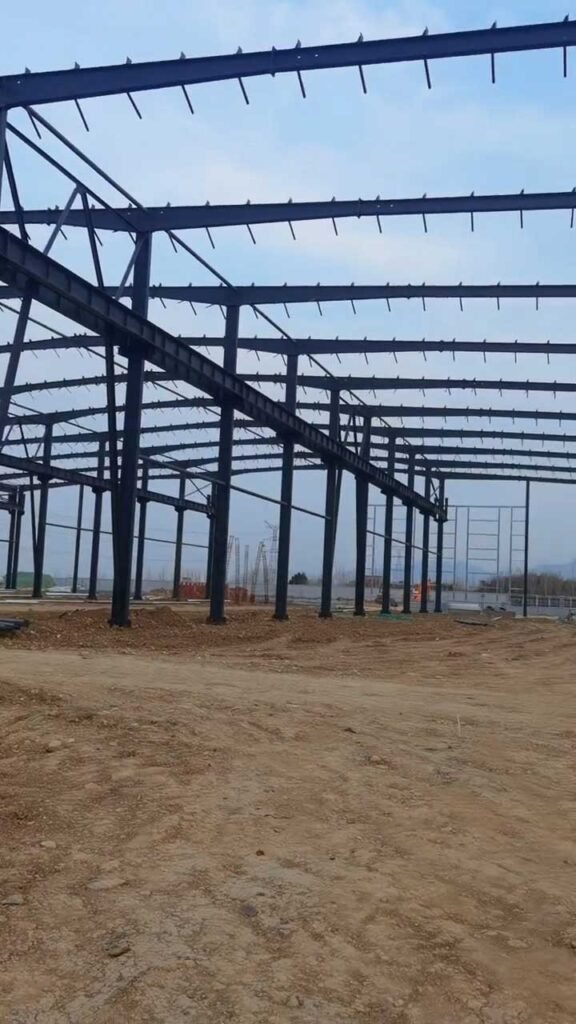
We do not simply ship steel and walk away. Successful site assembly is the final metric of our success.
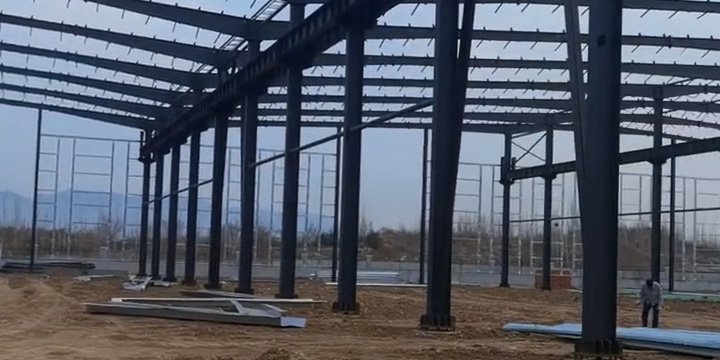
Every building is supplied with a comprehensive set of Erection Drawings. These are not generic manuals; they are specific 3D isometric views and 2D node details of your exact building.
Every column, beam, purlin, and brace is stamped with a unique part number. Column C-1 connects to Rafter R-1 using Bolt Set B-24. The process resembles assembling a massive structural kit. Because connections are 100% bolted, your local erection crew does not need advanced welding certifications—they only require a crane, mobile elevated work platforms, and torque wrenches.
For complex, large-scale industrial projects, we can dispatch seasoned technical supervisors to your site. They do not perform the physical labor; they guide your local contractor, interpret the drawings, enforce safety protocols, and ensure the assembly sequence is efficient.
OEM & Customized Warehouses
Many of our clients are Building Material Importers and Steel Building Distributors. We offer extensive OEM (Original Equipment Manufacturer) services. If you require standard warehouse kits branded with your company’s logo, specific regional color palettes, or proprietary structural detailing, we have the manufacturing flexibility to act as your silent, high-capacity backend factory.
OEM vs Standard Warehouse
| Feature | Standard Export Warehouse | OEM Partnership |
| Design Control | Factory standard optimization | Built exactly to your proprietary engineering specs |
| Branding | Unbranded or factory branded | Your logo on packaging, drawings, and steel marks |
| Component Uniformity | Standardized metric profiles | Adapted to match your local market preferences (e.g., specific purlin lips) |
Supplier Evaluation Checklist
Use this checklist before wiring any deposit to a supplier in China.
| Verification Step | Action Required by Buyer |
| 1. Entity Check | Request the Chinese Business License and run it through a translation tool. Ensure “Manufacturing” is listed in the business scope. |
| 2. Video Audit | Demand a live WhatsApp or WeChat video call from the production floor. Ask to see the CNC cutting machines and the welding lines operating. |
| 3. Engineering Audit | Ask for a preliminary structural layout and steel consumption estimate. A real factory will produce this quickly using PKPM or Tekla. |
| 4. Raw Material Proof | Ask to see their coil and plate storage yard. Small trading companies have no inventory. |
| 5. Reference Check | Request Bills of Lading (redacted for privacy) from past shipments to your specific country or region to prove export experience. |
Factory Audit Checklist (For Third-Party Inspectors)
If you hire SGS or an independent inspector, mandate they check:
Weld penetration depth (via UT reports).
Paint micron thickness (using a dry film thickness gauge).
Dimensional accuracy of bolt hole layouts against shop drawings.
Verification of Q355 vs Q235 steel tracking tags.
Packaging integrity prior to container stuffing.
Real Project Examples by Region
We tailor our engineering approach to the realities of your market:
Latin America & Caribbean: Supplying agricultural storage and logistics hubs. We heavily focus on cyclic wind load calculations and high-ductility seismic frames. Shipments are optimized for major ports like Manzanillo, Callao, and Kingston.
Africa: Providing robust mining workshops and government procurement facilities. We design for 100% bolted connections because skilled site welders are often scarce. We ensure packaging can withstand rough inland transport from ports like Mombasa, Dar es Salaam, or Durban.
Middle East: Supplying high-value industrial facilities in the UAE and Saudi Arabia. Engineering focuses on heavy PU sandwich panels to combat intense heat, and epoxy paint systems to resist coastal humidity.
Australia & New Zealand: We strictly adhere to AS/NZS codes. Projects here are driven by the need to offset exceptionally high local labor costs through rapid, precise, pre-engineered assembly.
Frequently Asked Questions (FAQ)
1. How do I verify a China steel warehouse supplier is a real factory and not a trading company? Request a live video call of the production line during working hours. Verify their Business License explicitly lists “manufacturing.” Check if their ISO 9001 certificate address matches the factory location, not a downtown office.
2. What is the standard lead time for a custom industrial warehouse? Once you approve the final shop drawings and remit the deposit, fabrication typically takes 3 to 5 weeks depending on the tonnage. Ocean transit adds 15 to 40 days depending on your destination port.
3. Do you provide the concrete foundation? We do not pour concrete, but we provide the exact foundation reaction forces (anchor bolt plans, shear/axial loads) so your local civil engineer can design the footings correctly for your soil conditions. We ship the anchor bolts to you in advance so you can pour concrete while the building is in transit.
4. How do you handle extreme wind and snow loads? We use software like PKPM and Tekla to simulate local environmental forces. We increase the web thickness of rafters for snow, and add heavy-duty X-bracing and thicker base plates for hurricane wind zones.
5. Can you manufacture to AS/NZS or Eurocode standards? Yes. We regularly export to markets requiring strict code compliance. We can apply CE marking (EN 1090) and ensure our welding procedures meet the necessary international standards.
6. What is the difference between Q235 and Q355 steel? Q355 is high-strength steel (Yield 355 MPa) used for primary load-bearing columns and beams (equivalent to ASTM A572 Gr 50). Q235 is standard steel (Yield 235 MPa) used for secondary framing like purlins and girts (equivalent to ASTM A36).
7. How do I unload the containers at my site? You will need a heavy-duty forklift (minimum 5-ton capacity) or a mobile crane. We provide a detailed packing list so you know exactly which components are in which container, allowing for staged unloading.
8. Are the buildings welded on-site or bolted? Our export designs are 100% bolted using high-strength structural bolts (e.g., Grade 10.9). This eliminates the need for expensive, time-consuming on-site welding and protects the factory-applied paint.
9. Can I inspect the steel before it ships? Absolutely. We encourage buyers to hire international third-party agencies (SGS, TUV, Bureau Veritas) to conduct a Pre-Shipment Inspection (PSI) at our facility to verify dimensions, paint thickness, and weld quality.
10. What payment terms do you accept for export? Standard B2B terms are 30% T/T deposit to begin detailing and raw material procurement, and a 70% T/T balance post-inspection, prior to container loading. For large-scale projects, LC (Letter of Credit) at sight is negotiable.
11. How long will the paint last before it rusts? With proper Sa2.5 shot blasting and a multi-layer epoxy/polyurethane system, paint can last 15-25 years depending on the environment. For zero-maintenance in corrosive areas, we recommend Hot-Dip Galvanizing (50+ year lifespan).
12. Can you do OEM manufacturing for my distribution company? Yes. We act as the backend factory for many global steel building distributors. We can manufacture to your proprietary designs and include your company branding on the packaging and structural plans.
13. What if parts are missing when the container arrives? We use barcode scanning during container stuffing to prevent omissions. Furthermore, we intentionally include a 3% to 5% surplus of all bolts, nuts, and small accessories.
14. Can the warehouse be expanded later? Yes. If you inform us during the design phase, we can engineer the end-walls as expandable rigid frames. When you are ready to expand, you simply unbolt the cladding and attach the new structural bays.
15. Do you supply the doors, windows, and insulation? Yes, we provide a complete turnkey envelope. This includes rolling shutter doors, aluminum windows, skylights, ventilators, and various sandwich panel insulations (PU, EPS, Rockwool).
Secure Your Project Economics Today
Stop absorbing the high costs and delays of local fabrication. Partnering with a specialized China steel warehouse supplier allows you to lock in your material costs, accelerate your construction schedule, and guarantee structural precision.
Whether you are an EPC contractor bidding on a government logistics hub, or an industrial investor expanding manufacturing capacity, our engineering team is ready to analyze your requirements.
Do not settle for generic quotes. Request comprehensive data to make an informed procurement decision.
Contact our Export Engineering Department today to request your:
Free Warehouse Design & Structural Layout
Detailed Steel Consumption Report
Project Budget Estimate (FOB & CIF)
Container Loading Plan
Supplier Qualification Documents & ISO Certificates
Live Factory Video Tour
Submit your preliminary drawings or dimensional requirements, and receive a highly detailed technical quotation within 24 hours.