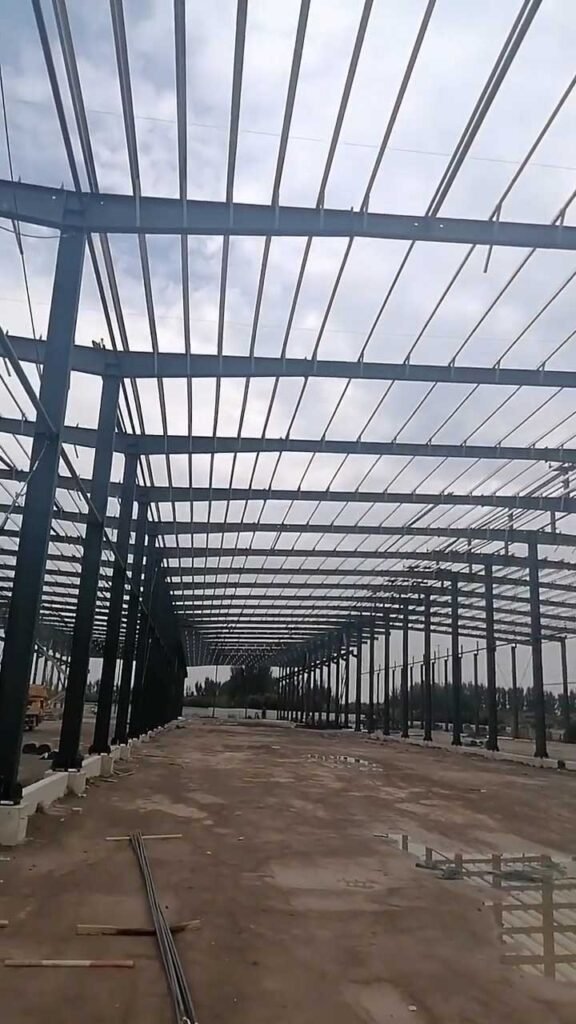
Steel Structure FOB China | Expert Import & Procurement
The Expert Guide to Procuring a Steel Structure FOB China
Procuring an industrial facility across international borders requires precision in engineering, contract negotiation, and logistics. For developers, EPC (Engineering, Procurement, and Construction) contractors, and industrial investors, sourcing a steel structure FOB China is often the most cost-effective method to acquire highly engineered, heavy-duty buildings.
China dominates the global prefabricated steel building market due to unparalleled raw material access, advanced CNC fabrication, and economies of scale. However, importing massive structural frames requires a deep understanding of Incoterms, structural steel grades, ocean freight optimization, and rigorous quality control.
This comprehensive guide is designed for international purchasing managers and engineers. It breaks down exactly how to evaluate a China steel structure manufacturer, understand the intricacies of an FOB quotation, and seamlessly manage your import logistics from the Chinese port to your global job site.
What Does FOB Mean for Steel Structure Exports?
Under Incoterms 2020, FOB (Free On Board) dictates that the seller (the Chinese factory) is responsible for the goods, including all costs and risks, until the cargo is safely loaded on board the vessel at the named port of departure (e.g., FOB Qingdao, FOB Shanghai).
When you purchase a FOB steel building China, the manufacturer covers:
Full structural engineering and detailing.
Procurement of all raw materials (steel plates, purlins, panels, hardware).
Fabrication, welding, surface treatment, and painting/galvanizing.
Quality control inspections and testing (NDT/UT).
Packing the components into shipping containers at the factory.
Inland transportation (trucking) from the factory to the departure port.
Export customs clearance in China and port handling charges (THC).
Once the containers rest on the deck of the outbound vessel, the risk and all subsequent costs (ocean freight, marine insurance, destination unloading, and import duties) transfer entirely to you, the buyer.
FOB vs CIF vs EXW Explained
Choosing the right shipping term dictates your control over logistics and total landed costs. While some buyers prefer the hands-off approach of CIF, experienced importers overwhelmingly choose to control the ocean freight themselves through FOB.
Incoterms Comparison Table: FOB vs CIF vs EXW
| Responsibility | EXW (Ex Works) | FOB (Free On Board) | CIF (Cost, Insurance & Freight) |
| Manufacturing & Packing | Seller | Seller | Seller |
| Loading at Factory | Buyer | Seller | Seller |
| Inland Freight (to China Port) | Buyer | Seller | Seller |
| China Export Customs | Buyer | Seller | Seller |
| Origin Port Charges (THC) | Buyer | Seller | Seller |
| Ocean Freight Cost | Buyer | Buyer | Seller |
| Marine Insurance | Buyer | Buyer | Seller |
| Destination Port Charges | Buyer | Buyer | Buyer |
| Import Customs & Duties | Buyer | Buyer | Buyer |
| Inland Freight (to Site) | Buyer | Buyer | Buyer |
Why Many Buyers Choose FOB China
Procuring an industrial steel building FOB is the industry standard for experienced international traders for several structural reasons:
Freight Cost Transparency: By booking the ocean freight through your own local forwarder under FOB terms, you avoid hidden markups that some suppliers add to CIF quotes.
Control Over Transit Times: You dictate the shipping line. If your project is urgent, your forwarder can book a direct route. If budget is paramount, they can book a longer transshipment route.
Destination Port Control: Under CIF, the seller’s forwarder controls the release of goods at your destination port, which can lead to extortionate and unexpected local handling fees. FOB ensures your chosen forwarder handles local release.
Simpler Customs: Handling Chinese export customs is notoriously difficult for foreign entities (as required in EXW). FOB forces the factory to clear export customs using their own export licenses.
What Is Included in an FOB Steel Structure Quote?
A professional FOB steel warehouse quotation is not a simple one-line price. It must be an exhaustive document detailing thousands of individual components.
If you request a quote and receive a single price per square meter without a breakdown, you are likely dealing with a trading company, not a genuine manufacturer. A rigorous quotation includes:
Primary Framing: Built-up H-section steel columns, roof rafters, and crane beams (typically Q355B/Q345B high-strength steel).
Secondary Framing: C-section or Z-section roof and wall purlins, tie rods, cross bracing, and sag rods (typically Q235B galvanized steel).
Building Envelope: Roof and wall cladding. This may be single-skin color-coated steel sheets or insulated sandwich panels (EPS, Rockwool, Glasswool, or Polyurethane).
Accessories: Ridge tiles, flashing, heavy-duty galvanized gutters, PVC downpipes, and edge covers.
Fasteners: High-strength structural bolts (Grade 10.9) for primary connections, standard bolts, and self-tapping screws for cladding.
Doors and Windows: Rolling shutter doors, personnel doors, aluminum alloy windows, and polycarbonate skylight panels.
Documentation: Erection drawings, anchor bolt layout plans, and detailed packing lists.
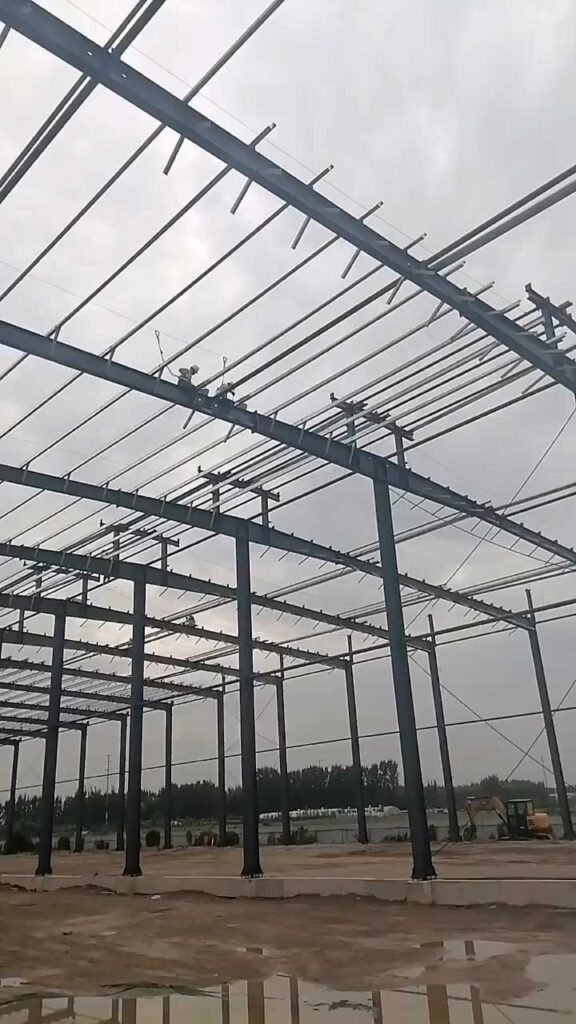
Engineering Support Before Shipment
A China steel building exporter is only as good as its engineering department. The building must survive the specific environmental loads of your job site.
Key Engineering Parameters
When you engage an exporter, you must provide local data so their engineers can utilize software (like Tekla, PKPM, or 3D3S) to design the frame.
Wind Load (km/h or kN/m²): Critical for coastal regions or hurricane zones. High wind loads require denser cross-bracing and thicker base plates.
Snow Load (kN/m²): Dictates roof pitch and the required thickness of roof purlins to prevent deflection under heavy snow accumulation.
Seismic Zone: Earthquakes require the design of moment-resisting frames with high ductility to absorb ground acceleration.
Live/Dead Loads: Accounting for suspended equipment, HVAC systems, or solar panels on the roof.
Steel Grades Explained
Chinese structural steel grades directly correspond to international standards:
Q355B (Yield Strength ≥ 355 MPa): Used for primary load-bearing members. It is equivalent to ASTM A572 Grade 50 (USA) and S355JR (Europe).
Q235B (Yield Strength ≥ 235 MPa): Used for secondary framing and plates. Equivalent to ASTM A36 (USA) and S235JR (Europe).
Factory Production Process & Tolerances
A true FOB prefabricated steel building is manufactured under strict factory conditions to ensure rapid on-site assembly. Precision is paramount; all connections are engineered to be bolted on-site to eliminate field welding.
CNC Cutting: Raw steel plates are cut using CNC plasma or multi-head flame cutters to ensure dimensional accuracy.
Assembly & Welding: Web and flange plates are assembled into H-beams. Top manufacturers use automated Submerged Arc Welding (SAW) machines for deep, defect-free full-penetration welds.
Straightening: The intense heat of SAW welding causes steel to warp. Hydraulic straightening machines restore perfectly flat flanges.
Hole Drilling: CNC three-dimensional drilling machines bore bolt holes with millimeter precision.
Surface Treatment (Shot Blasting): Steel is passed through an automated shot-blasting machine to reach the Sa2.5 standard. This removes all rust and mill scale, creating a rough profile for paint adhesion.
Quality Inspection Before Delivery
Before authorizing container loading, professional buyers demand comprehensive quality control. If a column is manufactured 5mm out of tolerance, or a bolt hole is misaligned, your site crew will be forced to halt construction and attempt dangerous field modifications.
| Inspection Category | Factory Standard to Verify |
| Material Traceability | Are Mill Test Certificates (MTC) provided for the Q355 steel coils? |
| Weld Quality | Do they perform Ultrasonic Testing (UT) on full-penetration welds? |
| Dimensional Accuracy | Is the bolt hole tolerance within ±1.5mm as per GB50205 standards? |
| Surface Prep | Was the steel shot-blasted to Sa2.5 prior to painting? |
| Paint Thickness | Is the Dry Film Thickness (DFT) measured with a gauge? (Typically 100-150 μm for epoxy paint). |
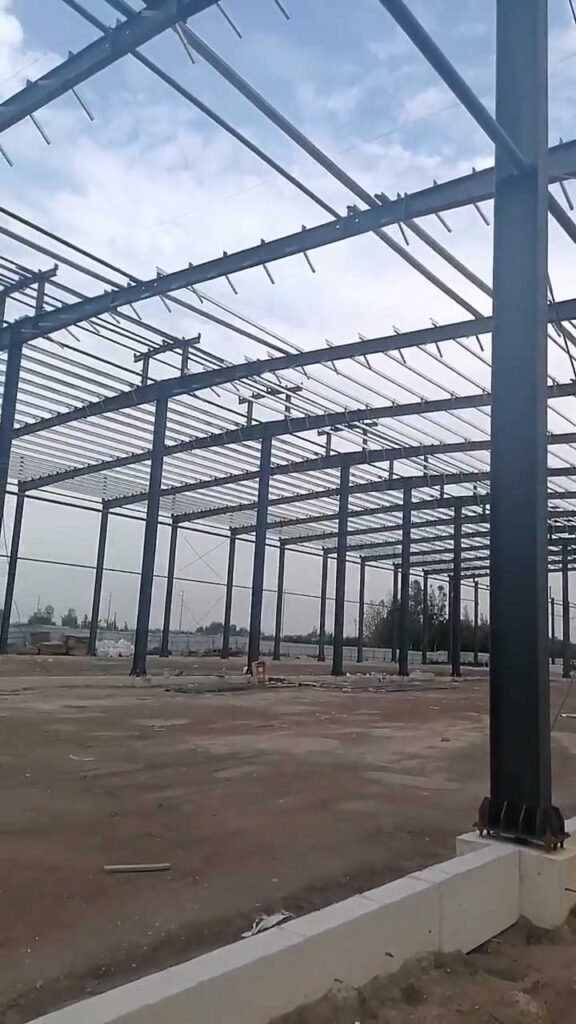
Packing Methods to Prevent Damage
Steel Pallets: Sandwich panels and fragile single-skin sheets must be packed in custom-welded steel frames. Wood pallets break under the weight.
Dunnage & Friction: Heavy H-beams must be separated by wooden dunnage to prevent steel-on-steel friction that will grind away the anti-corrosive paint during ocean transit.
Wire Lashing: Every bundle must be lashed tightly to the container’s interior D-rings using heavy-gauge steel wire to prevent shifting.
Moisture Protection: Hardware (bolts, nuts) must be oiled, bagged, and placed in wooden crates. Desiccants should be hung inside the container to prevent “container
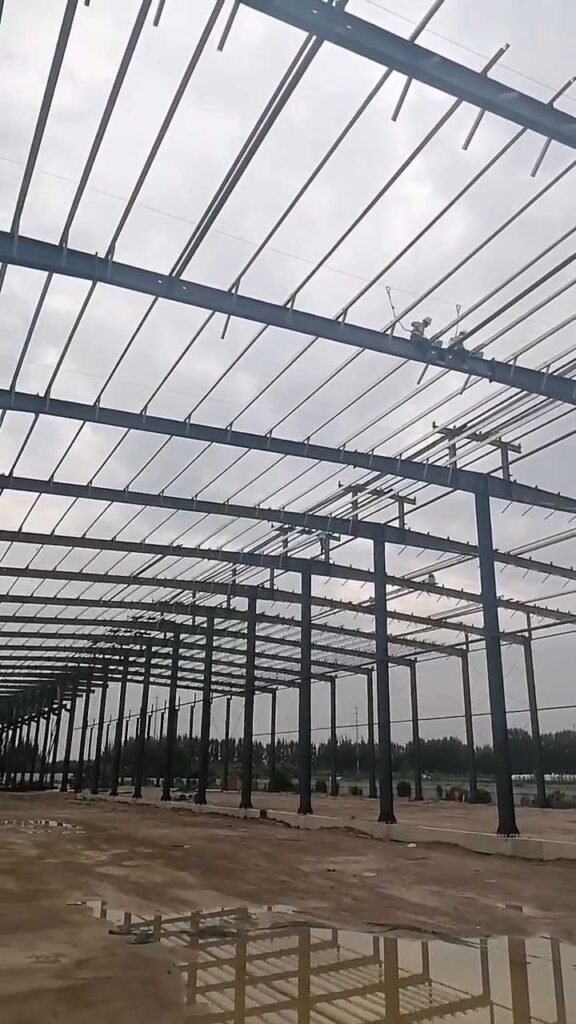
How to Compare FOB Quotations
Buyers frequently make the mistake of choosing the lowest bottom-line price. In the steel structure industry, a low price often means omitted components or compromised engineering.
Quotation Comparison Checklist
| Factor | Red Flag (Cheap Quote) | Green Flag (Professional Quote) |
| Weight | Does not specify total steel weight. | Clearly lists total tonnage of primary and secondary steel. |
| Material Grades | Vague references to “steel”. | Specifies Q355B for primary, Q235B for secondary. |
| Anti-Corrosion | Single coat of cheap alkyd paint. | Epoxy zinc-rich primer + Polyurethane topcoat (lists DFT). |
| Fasteners | Not included or standard grade. | High-strength 10.9 grade bolts specifically listed. |
| Inclusions | Misses downpipes, gutters, or flashing. | Comprehensive list of all envelope accessories. |
Common Mistakes Buyers Make
Ignoring Local Codes: Importing a building engineered to standard Chinese load parameters without adjusting for your local municipal codes. When the building inspector arrives, it will fail compliance.
Vague RFQs: Asking for “a 1000 square meter warehouse quote” without providing eaves height, wind speed, or intended use (e.g., will it have an overhead crane?).
Trading Company Traps: Buying from an export agent posing as a factory. This adds a 15-25% markup and creates a massive communication barrier when discussing complex structural detailing.
Professional Buyer FAQ
1. How do I calculate my total landed cost from an FOB price? Add the FOB price + Ocean Freight + Marine Insurance + Destination Port Handling (THC) + Import Duties + Local Trucking to your site.
2. Can you load a heavy steel structure into a standard 20ft container? Usually no. Structural steel columns are often 6 to 11 meters long, requiring 40ft High Cube (40HQ) containers. Heavy, short components (like plates or bolts) might go in a 20ft to maximize weight limits without wasting space.
3. What happens if components are damaged during shipping? Because you purchased FOB, damage during ocean transit is covered by the Marine Insurance policy you purchased. If the damage was due to negligent factory packing, a reliable manufacturer will replace the parts, but having insurance is mandatory.
4. How is the factory paint protected during container loading? Professional factories use nylon lifting slings (not steel chains) to load beams. They use wooden dunnage between layers in the container and secure everything with heavy wire lashing.
5. Do you provide installation services overseas? Most manufacturers do not send full labor crews overseas due to visa and cost issues. Instead, they provide detailed 3D erection drawings and can dispatch 1 or 2 engineering supervisors to guide your local labor force.
6. What is the difference between Hot-Dip Galvanized and Painted steel? Hot-dip galvanizing submerges the steel in molten zinc, offering 50+ years of rust protection, ideal for corrosive or coastal environments. Painting (Epoxy primer + PU topcoat) is more economical and suitable for dry, standard industrial environments.
7. How do I verify a Chinese supplier is a real factory? Request a copy of their Chinese Business License and check the business scope. Ask for ISO 9001 and CE EN1090 certificates. Finally, request a live WeChat or Zoom video call to walk through the fabrication workshop.
8. What payment terms are standard for FOB steel buildings? Standard B2B terms are 30% T/T (Telegraphic Transfer) as a deposit to begin engineering and raw material purchasing, and 70% T/T balance paid after the buyer receives the inspection report and before the containers leave the factory.
9. Can you design for overhead bridge cranes? Yes. You must provide the crane’s lifting capacity (e.g., 5-ton, 10-ton), span, and lifting height. The engineers will design heavy-duty crane beams and corbels onto the primary columns to support the dynamic load.
10. How long does it take to assemble a steel warehouse? A standard 2,000 square meter prefabricated warehouse can typically be erected in 30 to 45 days by an experienced crew of 6-8 workers, assuming the concrete foundation is already cured.
11. Do I need to weld anything on site? No. A professionally engineered export building is designed for 100% bolted connections. Field welding destroys the factory anti-corrosion coating and relies on the variable skill of local labor.
12. What documents do I need to clear customs? Generally, you need the Bill of Lading, Commercial Invoice, Packing List, and Certificate of Origin. Always check with your local customs broker to see if specific import permits are required for steel products.
Secure Your Industrial Procurement Today
Procuring a steel structure FOB China is a major capital investment. Success requires partnering with a manufacturer that possesses deep engineering expertise, rigorous quality control, and flawless export logistics.
Stop relying on vague square-meter estimates and intermediary trading companies. Work directly with a heavy industrial manufacturer to secure your supply chain and reduce your total project costs.
Ready to start your project? Contact our engineering team today to request:
A Comprehensive FOB Quotation (Itemized by Tonnage)
Container Loading Optimization Plan
Current Ocean Freight Estimates (via our Forwarder Network)
Preliminary Structural Layout Drawings
Our Factory Certifications and Quality Control Portfolio
Submit your project dimensions (Length x Width x Height) and local weather loads today. Receive a professional consultation and quotation within 24 hours.