
The Chilean Builder’s Guide to Custom Steel Warehouse Construction
A 20-Year Veteran’s Guide to Steel Warehouses in Chile
If you have spent any time managing construction projects in Chile, you know the geography does not forgive mistakes. From the heavy industrial mining operations in the bone-dry Atacama Desert to the massive agro-export hubs in the Central Valley and the freezing, wind-battered coastlines of Punta Arenas, building here requires serious local knowledge.
Over my 20 years of working alongside Chilean developers, engineers, and site managers, I have watched the market shift entirely. We used to rely heavily on local steel fabricators or traditional concrete tilt-up construction. However, local steel mills frequently face massive backlogs, and on-site welding labor has become prohibitively expensive and incredibly slow. After the massive 8.8 magnitude earthquake in 2010, the enforcement of structural codes rightly tightened, making traditional builds even more complex.
Today, the most profitable and reliable way to develop industrial real estate in this country is to import prefabricated structures. But you cannot buy an off-the-shelf shed and expect it to survive here. You need a dedicated custom steel warehouse supplier who understands Chilean building codes, complex inland logistics, and specific industry demands.
In this guide, I will walk you through exactly what it takes to design, engineer, and import a specialized facility for the Chilean market, and why a custom approach is the only way to protect your investment.
Planning a Custom Warehouse Building in Chile
A common mistake developers make is trying to force a generic building design to fit a highly specialized local operation. The Chilean economy is driven by distinct sectors—copper and lithium mining, fruit and salmon exports, and booming e-commerce logistics around Santiago. Each of these requires a fundamentally different custom warehouse building.
Let’s look at the agro-export sector operating out of Rancagua and Curicó. Chile is one of the world’s largest exporters of cherries, grapes, and berries. These logistics operators do not just need a roof; they need advanced cold storage facilities that can handle massive volumes during peak harvest windows.
If you attempt to build a cold storage facility using traditional blockwork, you will struggle to achieve the necessary thermal envelope. By acting as your custom steel warehouse supplier, we engineer the structural frame specifically to integrate heavy insulated metal panels (IMPs)—typically polyurethane (PU) or polyisocyanurate (PIR) cores. We calculate the exact weight of these heavy thermal walls, along with the roof-mounted HVAC and refrigeration units, and reinforce the primary steel columns and roof purlins to carry those specific dead loads. Everything fits perfectly on-site because it was engineered as a single, cohesive system in the factory.
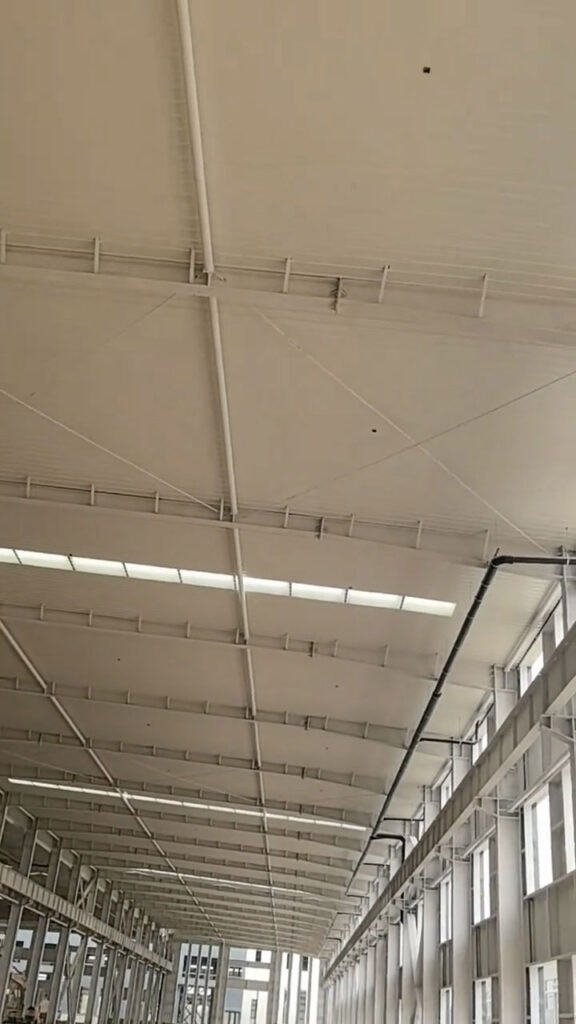
Seismic and Climatic Industrial Warehouse Design
You cannot talk about construction in Chile without talking about earthquakes. The country sits squarely on the Ring of Fire. Building authorities strictly enforce the Norma Chilena (specifically NCh433 for seismic design and NCh1537 for structural loads).
If an overseas supplier tries to sell you a lightweight structure based on generic international codes, they are putting your project and your people at extreme risk.
Proper warehouse design for Chile requires rigorous dynamic structural analysis. A rigid, heavy concrete building absorbs the full, violent force of an earthquake, which often leads to structural cracking or catastrophic failure. Pre-engineered steel, on the other hand, is highly ductile. When designed correctly, a steel frame can flex, absorb, and dissipate seismic energy without collapsing.
Here is how we adapt our engineering for the Chilean landscape:
Seismic Zones (NCh433): We increase the dimensions of the primary H-beam columns and rafters, utilizing high-yield steel (Q355B/ASTM A572 Gr 50). We also engineer heavy-duty moment connections and specialized base plates that allow the structure to ride out ground acceleration.
Southern Snow and Wind: If you are erecting a building in the Los Lagos or Magallanes regions, earthquakes are only half the battle. You are dealing with intense Patagonian winds and heavy snow loads. We decrease the spacing between roof purlins and specify thicker gauge steel cladding with heavy-duty structural fasteners to prevent roof tear-off during winter storms.
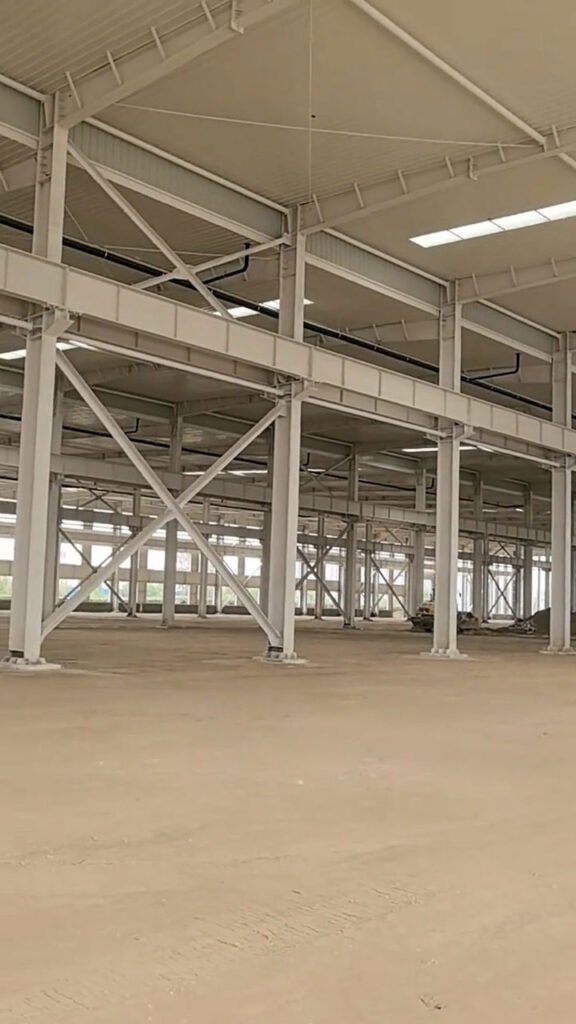
Engineering a Heavy-Duty Industrial Steel Warehouse
When we supply projects up north in regions like Antofagasta, Calama, or Tarapacá, we are usually dealing with the mining sector. Mining support facilities are subjected to absolute abuse.
An industrial steel warehouse supporting a copper mine is not just storing pallets; it is housing massive dump trucks, drilling equipment, and raw materials. These buildings require massive clear spans—often 40 to 60 meters wide without a single interior column—so heavy machinery can maneuver without risk of collision.
Furthermore, these facilities almost always require overhead bridge cranes to lift heavy engine blocks or equipment parts. You cannot simply bolt a 20-ton crane to a standard steel column. We custom-engineer crane runway beams, corbels, and step-columns directly into the primary structural frame at the factory.
Fighting Coastal and Desert Corrosion The Atacama Desert is highly corrosive due to mineral dust, and coastal port cities like Mejillones and San Antonio deal with severe saltwater spray. A standard layer of red oxide primer will peel off in months under these conditions. As an experienced custom steel warehouse supplier, we process the raw steel through automated shot-blasting machines to remove all mill scale, then apply industrial-grade zinc-rich epoxy primers and marine-grade polyurethane topcoats. If required, we can hot-dip galvanize the entire structural frame, giving you a building that will last 50 years in the harshest environments on earth.
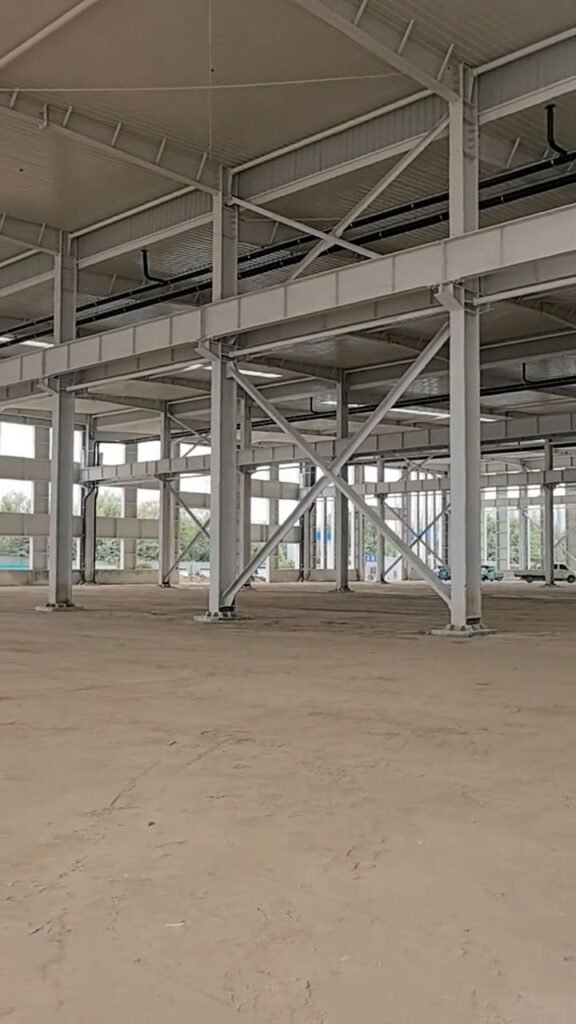
Partnering with a Global Custom Steel Warehouse Manufacturer
You might wonder why you shouldn’t just hire a local fabrication shop in Santiago or Concepción to weld your structure. Having managed projects locally for two decades, I can give you the hard truth: local capacity and labor costs.
When the mining sector booms, local steel mills are instantly backlogged. You could wait six months just to get your raw steel allocation. Then, you have to pay local welders hourly rates that continuously eat into your capital expenditure. Finally, all that welding happens outdoors, subject to rain delays and variable quality control.
By partnering with an automated global steel warehouse manufacturer, you completely bypass the local bottleneck.
Our factory utilizes CNC (Computer Numerical Control) cutting, punching, and submerged arc welding. We lock in your material costs upfront, shielding your budget from local inflation. Every single bolt hole aligns perfectly. When the container arrives at your job site, your local rigging crew does not need to cut or weld anything. They simply use cranes and impact wrenches to bolt the structure together. This reduces your on-site labor hours by up to 50% and virtually eliminates site waste.
The Reality Check: Traditional vs. Custom Imported Steel
Let’s look at a practical breakdown of what happens on a typical 3,000-square-meter project in Chile when comparing old methods to our pre-engineered system.
| Project Metric | Traditional Concrete / Local Weld-on-Site | Imported Custom Pre-Engineered Steel |
| NCh433 Seismic Compliance | Requires massive, heavy shear walls that consume usable floor space. | Highly ductile. Smaller structural footprint safely absorbs seismic shock. |
| Construction Speed | 8 to 12 months. Constant delays from rain, curing times, and labor shortages. | 3 to 4 months. Bolted mechanical assembly happens rapidly, regardless of weather. |
| Material Cost Predictability | Poor. Highly vulnerable to local steel price spikes and extended labor hours. | Excellent. Fixed-price factory contract. You know exactly what the structure costs before dirt is moved. |
| Clear Span Capacity | Very limited. Requires interior columns that ruin logistics layouts. | Massive. Capable of 50+ meter clear spans for unobstructed racking and forklift movement. |
| Foundation Costs | Extremely expensive. Requires deep excavations to support heavy masonry loads. | Economical. The lightweight nature of steel significantly reduces required concrete volumes. |
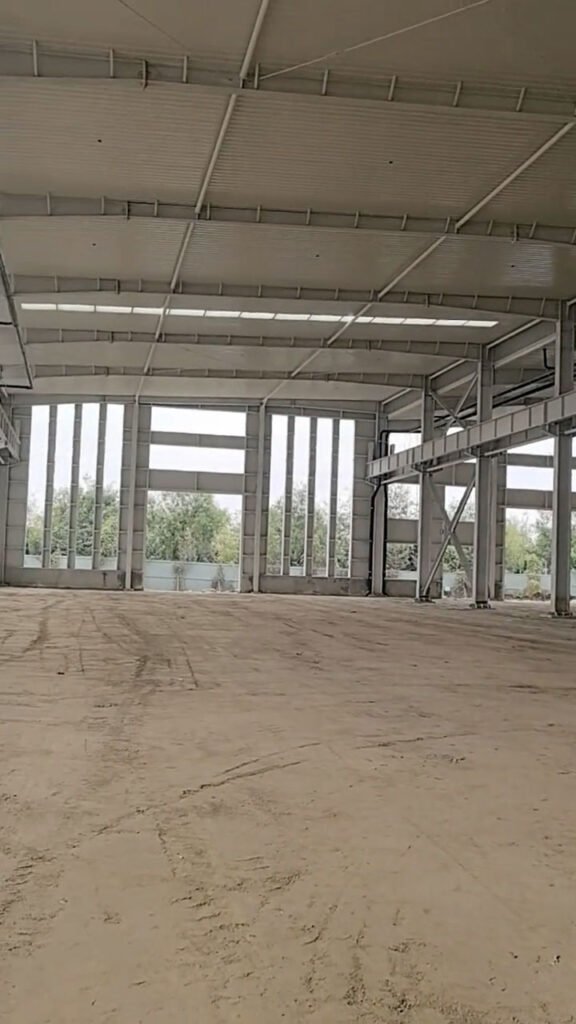
Selecting a Custom Steel Warehouse Supplier for Chilean Logistics
Producing excellent steel in a factory means nothing if it arrives in Chile damaged, or if the logistics of moving it inland are impossible. Route 5 (Ruta 5 Sur/Norte) is a great highway, but getting massive steel beams up winding mountain passes to high-altitude mining sites requires strategic foresight.
A professional warehouse supplier manages the logistics at the manufacturing stage. We do not just blindly stuff steel into shipping containers. We utilize 3D packing software to optimize the weight distribution inside standard 40-foot High Cube and Open Top containers.
If your project requires a 50-meter clear span roof rafter, that piece of steel physically cannot fit inside a 12-meter container. Instead of forcing you to hire specialized oversized flatbed trucks at the Port of Valparaíso (which costs a fortune), we engineer high-strength bolted splice joints. We manufacture the massive rafter in transportable sections, pack them safely in standard containers, and provide clear assembly drawings so your local team can safely splice them back together on the ground before lifting them into place.
We also supply comprehensive packing lists translated into Spanish, alongside original Mill Test Certificates (MTCs) and Bill of Lading documents, ensuring your customs broker can clear the cargo rapidly through the Servicio Nacional de Aduanas without incurring expensive demurrage fees at the port.
Future-Proof Your Chilean Operations
After 20 years in this industry, the lesson is simple: you cannot cut corners when building commercial infrastructure in Chile. The ground will shake, the winds will howl, and the operational demands of your tenants will only increase.
Relying on slow, expensive local construction methods places your capital at unnecessary risk. By importing a precision-engineered structural solution from a trusted custom steel warehouse supplier, you take control of your project timeline, secure a building engineered specifically for your local climate and seismic zone, and drastically lower your total cost of ownership.
We do not just sell generic steel kits; we deliver custom structural solutions built to perform in one of the most demanding geographical environments on the planet. Our engineering department is ready to review your architectural plans, your exact location in Chile, and your operational requirements to develop a structural strategy that works.
Request a Customized Warehouse Solution
Stop fighting local delays and unpredictable costs. Contact us today with your target dimensions (length, width, eave height) and project location. Our engineering team will provide a comprehensive, transparent quotation for a steel structure designed to conquer the Chilean landscape.