
How to Evaluate and Audit a Structural Steel Fabrication Company
Defining a Genuine Steel Fabrication Company
A true steel fabrication company is fundamentally an engineering and processing entity, not merely a material trader. While a trading house buys and sells standard profiles, a genuine fabrication partner takes raw carbon steel plates and profiles and transforms them into complex, load-bearing structures.
This transformation requires a robust infrastructure of heavy machinery, including CNC plasma cutting tables, automated submerged arc welding (SAW) lines, shot blasting chambers, and dedicated quality inspection laboratories. Furthermore, a professional company holds internationally recognized certifications—such as ISO 9001 for quality management, CE marking for European structural compliance (EN 1090), and CWB certification for the Canadian market. When you audit a potential partner, you are evaluating their capacity to digest complex 3D BIM models (like Tekla Structures) and execute those designs with millimeter precision.
Structural Steel Fabrication vs. Basic Material Trading
One of the most common critical errors made by OEM buyers and infrastructure developers is confusing manufacturing with material supply. Understanding the distinction is vital for maintaining project timelines and structural integrity.
Fabrication vs Trading Comparison Matrix
| Capability / Feature | Basic Trading Company | Genuine Fabrication Partner |
| Core Business Model | Buying and reselling standard materials. | Engineering, cutting, welding, and assembling. |
| In-House Engineering | None. Relies entirely on your drawings. | Advanced (Tekla, CAD). Performs clash detection. |
| Quality Control (QC) | Basic visual inspection before shipping. | In-house NDT (UT, MT, PT), dimensional scanning. |
| Traceability | Often poor. MTCs may not match heat numbers. | 100% traceability from raw plate to final weld. |
| Customization | Limited to standard lengths and profiles. | Infinite. Custom plate girders, heavy box columns. |
True structural steel fabrication involves taking ownership of the production lifecycle. If a flange is warped during welding, a fabricator has the hydraulic straightening machines to correct it. A trader merely ships the warped beam.
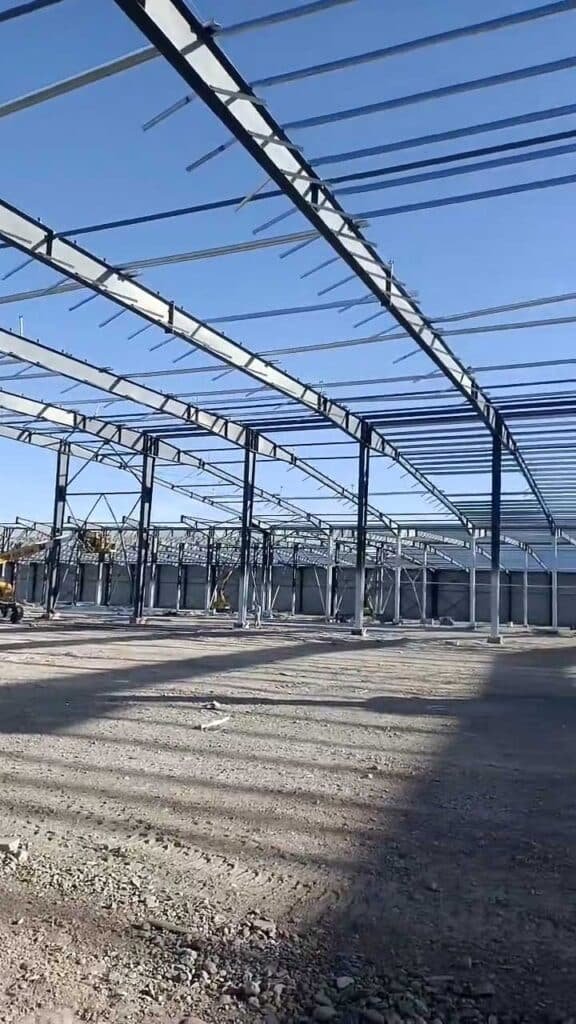
Core Industries Relying on Custom Steel Fabrication
Heavy industry cannot function on off-the-shelf solutions. Every project requires unique load calculations, specific seismic resistance, and tailored spatial designs. Our expertise in custom steel fabrication spans multiple high-demand sectors:
Mining and Metallurgy: Conveyor galleries, crusher structures, and heavy equipment platforms requiring abrasion-resistant steel and dynamic load engineering.
Oil and Gas: Pipe racks, offshore platform components, and modular refineries built to stringent API and ASTM specifications.
Infrastructure and Bridges: Heavy box girders and pedestrian bridge frameworks requiring 100% full-penetration welds and advanced fatigue resistance.
Industrial Manufacturing: Heavy portal frames equipped with structurally integrated crane girders capable of supporting 50-ton overhead bridge cranes.
Renewable Energy: Solar mounting structures and wind turbine towers requiring highly standardized mass production and advanced anti-corrosion treatments.
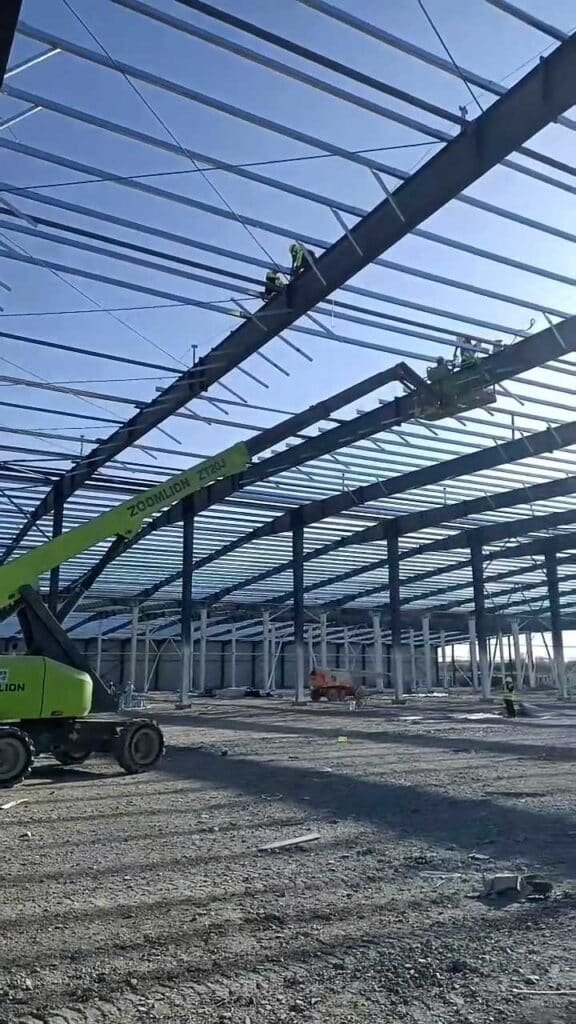
Engineering Review Inside a Steel Fabrication Factory
Before a single sheet of steel is cut, rigorous engineering protocols must be executed. A reputable steel fabrication factory acts as the final gatekeeper against design flaws.
Shop Drawings and BIM Coordination
When an EPC contractor submits architectural or structural blueprints, our in-house engineering team translates these into highly detailed shop drawings using Tekla Structures. We create a 1:1 scale 3D BIM model of the entire project. This process automatically identifies “clashes”—for example, a structural brace interfering with an HVAC duct route—long before manufacturing begins.
Furthermore, the software generates automated CNC data (NC files) that are fed directly into our processing equipment. This eliminates human error in manual measuring and marking, ensuring that when components arrive on site thousands of miles away, the bolt holes align perfectly.
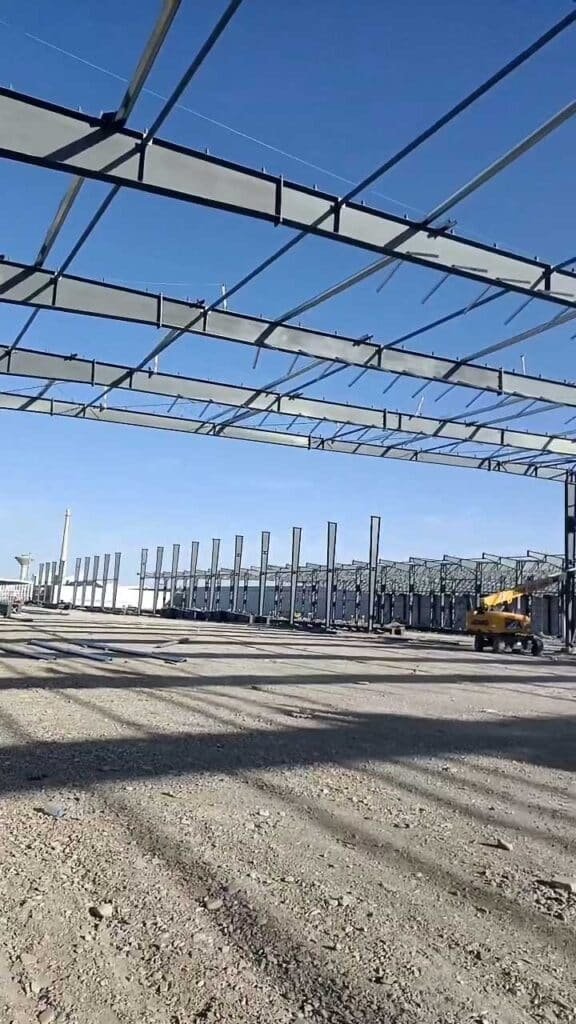
Material Grade Selection by a Steel Fabrication Manufacturer
The chemical composition and mechanical properties of your steel dictate the entire lifespan of your project. As a leading steel fabrication manufacturer, we manage strict supply chains with tier-one steel mills (such as Baosteel or Ansteel) to ensure absolute material integrity.
International Steel Grade Equivalency
Understanding equivalent grades is essential for cross-border projects. Below is a professional comparison of common structural grades utilized in our facilities:
| Chinese Standard (GB) | US Standard (ASTM) | European Standard (EN) | Yield Strength | Primary Application |
| Q235B | ASTM A36 | EN 10025 S235JR | 235 MPa | Secondary framing, purlins, handrails. |
| Q355B/C/D | ASTM A572 Gr. 50 | EN 10025 S355JR | 355 MPa | Primary load-bearing columns, rafters, crane beams. |
| Q420 | ASTM A572 Gr. 60 | EN 10025 S420 | 420 MPa | High-stress infrastruc |
CNC Processing Capabilities of a Steel Processing Company
Modern fabrication is entirely reliant on computer numerical control. A top-tier steel processing company utilizes these technologies to achieve maximum throughput with zero deviation.
Advanced Cutting and Assembly
CNC Flame and Plasma Cutting: Raw steel plates up to 100mm thick are sliced with extreme precision. CNC plasma is used for thinner plates to prevent heat-affected zone (HAZ) distortion, while multi-head flame cutters slice heavy plates for thick column flanges.
Automated H-Beam Assembly Lines: We do not rely on manual tacking for standard beams. Plates are fed into an automatic H-beam assembly machine that aligns the web and flanges hydraulically, ensuring perfect perpendicularity before welding.
CNC Drilling and Punching: For connection plates and base plates, high-speed CNC 3D drilling machines bore holes simultaneously from multiple axes, achieving sub-millimeter tolerances required for seamless bolted connections on site.
Advanced Welding Standards in a Steel Fabrication Workshop
Welding is the most critical variable in structural integrity. A certified steel fabrication workshop strictly adheres to global welding codes (AWS D1.1, EN 1090, CSA W59).
Welding Methodologies
Submerged Arc Welding (SAW): Used for long, continuous welds on primary H-beams and box columns. The arc is struck beneath a blanket of granular flux, eliminating spatter and UV radiation while providing deep, consistent penetration and a cosmetically flawless weld bead.
Gas Metal Arc Welding (GMAW/MIG): Utilized for attaching stiffener plates, base plates, and structural cleats. This provides high deposition rates with excellent control for shorter, complex joints.
Flux-Cored Arc Welding (FCAW): Employed for heavy structural nodes where deep penetration and rapid deposition in out-of-position welding are required.
Welding Procedure Specifications (WPS)
No welder strikes an arc without a WPS. This document details the exact parameters—voltage, amperage, travel speed, shielding gas mixture, and pre-heat temperatures. Every WPS is backed by a Procedure Qualification Record (PQR), proving that the specific weld recipe has been destructively tested and certified by independent metallurgical engineers.
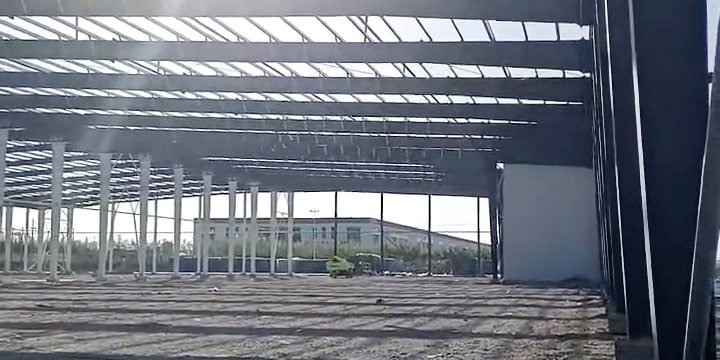
Precision Control by a Structural Steel Manufacturer
Deflection, sweep, and camber must be strictly controlled. An elite structural steel manufacturer implements multi-stage dimensional checks.
Dimensional Tolerance Control
After heavy welding, steel naturally distorts due to thermal stress. We utilize heavy-duty hydraulic flange straightening machines to correct any thermal warpage, ensuring the H-beam flanges remain perfectly flat and parallel.
For highly complex, multi-nodal connections (such as space frames or complex stadium trusses), we conduct a Trial Assembly (Pre-assembly) inside our factory before shipping. Components are temporarily bolted together on a specialized jig to verify that site assembly will be 100% clash-free, radically reducing expensive on-site modifications.
Surface Treatment from your Steel Fabrication Supplier
Corrosion is the enemy of industrial steel. Your steel fabrication supplier must offer versatile surface treatment options tailored to your project’s specific environmental corrosivity category (ISO 12944: C1 to C5-M).
Surface Preparation
Paint will invariably fail if applied over mill scale or rust. All structural steel is passed through a totally enclosed shot-blasting machine, utilizing steel grit to strip the surface to an Sa 2.5 standard (Near-White Metal). This creates the necessary microscopic surface profile (roughness) for the coating to bond effectively.
Painting vs. Hot-Dip Galvanizing
| Treatment Method | Process | Ideal Application | Lifespan / Maintenance |
| Industrial Coating (Painting) | Epoxy zinc-rich primer + Polyurethane topcoat. | Indoor warehouses, standard commercial buildings. | 10-15 years before touch-ups depending on environment. |
| Hot-Dip Galvanizing (HDG) | Dipping steel into a bath of molten zinc (450°C). | Chemical plants, coastal structures (C4/C5), agricultural sheds. | 50+ years. Cathodic protection prevents rust even if scratched. |
Quality Assurance in Steel Fabrication Services
Providing raw metal is easy; proving its integrity is difficult. The hallmark of professional steel fabrication services is a transparent, documented QA/QC workflow.
Non-Destructive Testing (NDT)
Visual inspection is insufficient for load-bearing structures. Our certified inspectors (ASNT Level II/III) utilize:
Ultrasonic Testing (UT): High-frequency sound waves are pulsed into full-penetration welds to detect internal voids, lack of fusion, or subsurface cracks.
Magnetic Particle Testing (MT): Used to detect surface and slightly subsurface discontinuities in ferromagnetic materials.
Radiographic Testing (RT): X-ray testing utilized for critical pressure vessels or extremely high-stress bridge components.
Essential QC Documentation
Upon delivery, buyers receive a comprehensive handover package:
Mill Test Certificates (MTC): Tracing the chemical and physical properties back to the original steel batch.
Dimensional Inspection Reports: Verifying length, bolt hole alignment, and camber.
NDT Reports: Officially signed off by certified third-party inspectors.
Coating Thickness Reports: Measured via digital dry film thickness (DFT) gauges to ensure compliance with the specified micron (μm) requirements.
Professional Buyer FAQ
1. Can you fabricate exactly according to our engineering drawings? Yes. We are an OEM fabricator. If you have finalized structural drawings, we will convert them into shop drawings, verify the nodes, and fabricate exactly to your specifications.
2. What file formats do your engineering teams accept? We accept standard CAD formats (.dwg, .dxf), 3D models (Tekla .db1, .ifc), and structural calculation software files (PKPM, SAP2000), alongside standard PDF blueprints.
3. What international welding standards do you follow? Our welders and procedures are qualified under AWS D1.1 (American), EN 1090 (European), and CSA W59 (Canadian) standards, ensuring global compliance.
4. Can third-party inspections (SGS, BV, TUV) be arranged? Absolutely. We welcome and frequently host independent third-party inspectors like SGS or Bureau Veritas for factory audits, in-process inspections, and final dispatch sign-offs.
5. What dimensional tolerances can you achieve? We adhere stringently to the tolerances specified in standard codes (such as AISC 303-16 or EN 1090-2), typically achieving bolt-hole alignments within ±1.0 mm to guarantee seamless site erection.
6. Do you provide MTC and NDT reports? Yes. A comprehensive quality dossier including Mill Test Certificates (MTC), NDT test results (UT/MT), and dimensional inspection reports is provided prior to shipment.
7. How are fabricated components packed to prevent transit damage? Components are separated by dunnage, banded onto reinforced steel pallets, and loaded into containers. Machined surfaces and bolt holes are protected, and touch-up paint is always included in the shipment.
8. What is the typical production lead time for a large project? Lead times depend on tonnage and complexity. However, standard structural fabrication for a 500-ton project typically takes 30 to 45 days after the final approval of shop drawings.
9. Can you process both light-gauge and heavy structural steel? Yes. Our workshops are divided into light steel processing (purlins, girts, thin-walled tubes) and heavy fabrication lines (multi-ton box columns, plate girders, crane beams).
10. Do you provide hot-dip galvanizing in-house? We partner with certified, environmentally compliant local galvanizing plants that strictly adhere to ISO 1461 or ASTM A123 standards, maintaining full QC oversight throughout the process.
11. How do you handle design discrepancies found in our provided drawings? During our Tekla BIM modeling phase, if any clashes or load-path discrepancies are detected, our engineers generate an RFI (Request for Information) report with proposed solutions for your lead engineer to approve.
12. Is it possible to conduct a Trial Assembly at your factory? Yes. For highly complex geometries or critical connection nodes, we perform a physical trial assembly on our workshop floor to guarantee flawless fitment before container loading.