
Steel Structure Design and Fabrication: A U.S. Builder's Expert Guide
Bridging the Gap Between Blueprint and Job Site: The Reality of Steel Structure Design and Fabrication
If you have spent any meaningful time in the U.S. commercial construction industry over the last two decades, you know that the margin for error is shrinking every single year. Whether we are putting up a logistics distribution center in the Texas Triangle, a manufacturing plant in the Rust Belt, or an agricultural processing facility in the Central Valley of California, the challenges remain the same: skilled labor shortages, aggressive project schedules, and zero tolerance for budget overruns.
I have spent 20 years managing job sites, dealing with structural engineers, and coordinating with steel erectors. The fastest way to bleed money on a commercial project is a disconnect between the engineering firm drawing the plans and the fabrication shop cutting the steel. When bolt holes don’t align in the field, or when a column arrives without the required crane corbel, the resulting Requests for Information (RFIs), back-charges, and crane rental delays can completely destroy your project’s profitability.
The only way to guarantee a seamless build is to adopt a fully integrated approach to steel structure design and fabrication. By placing the engineering calculations, 3D detailing, and automated manufacturing under a single umbrella, you eliminate the communication gaps that plague traditional fragmented construction.
In this comprehensive guide, I will break down exactly how professional steel engineering works, how factory-floor fabrication mitigates field risks, and what specific U.S. codes (IBC, AISC, ASTM) your supplier must strictly follow to ensure your building gets permitted and erected without a hitch.
Steel Engineering Design
Every successful project begins long before the first piece of steel is cut. In the United States, obtaining a building permit is a rigorous process. Local building departments do not care about your timeline; they care about public safety and strict adherence to the International Building Code (IBC) and the American Institute of Steel Construction (AISC) 360 specifications.
A professional Steel Engineering Design process is not just about drawing a frame; it is about intense mathematical structural calculations tailored to the exact ZIP code of your job site.
Our engineering teams utilize advanced software—primarily Tekla Structures and SDS/2—to build a 1:1 digital twin of your building. This 3D modeling process allows us to run dynamic load simulations based on the ASCE 7 (Minimum Design Loads for Buildings and Other Structures) criteria:
Wind Loads: If you are building a warehouse in Miami, Florida, or along the Gulf Coast, the structure must be engineered to withstand Category 5 hurricane wind speeds (upward of 170+ mph). We calculate the wind uplift and design heavy-duty rigid frames, robust cable bracing, and specialized cladding fasteners to prevent structural tear-off.
Snow Loads: A project in Minnesota or Upstate New York faces massive ground snow loads. Our structural calculations dictate the necessary reduction in purlin spacing and an increase in the section modulus of the roof rafters to prevent buckling under the immense dead weight of ice and snow.
Seismic Activity: For projects in California or the Pacific Northwest, high seismic base shear is the primary concern. We engineer high-ductility moment connections that allow the structural frame to flex and absorb earthquake tremors without catastrophic failure.
During this phase, we also calculate internal live loads and collateral loads. If you plan to hang heavy HVAC units, extensive fire sprinkler mains, or a solar panel array from the roof, those exact weights are engineered into the rafters from day one.
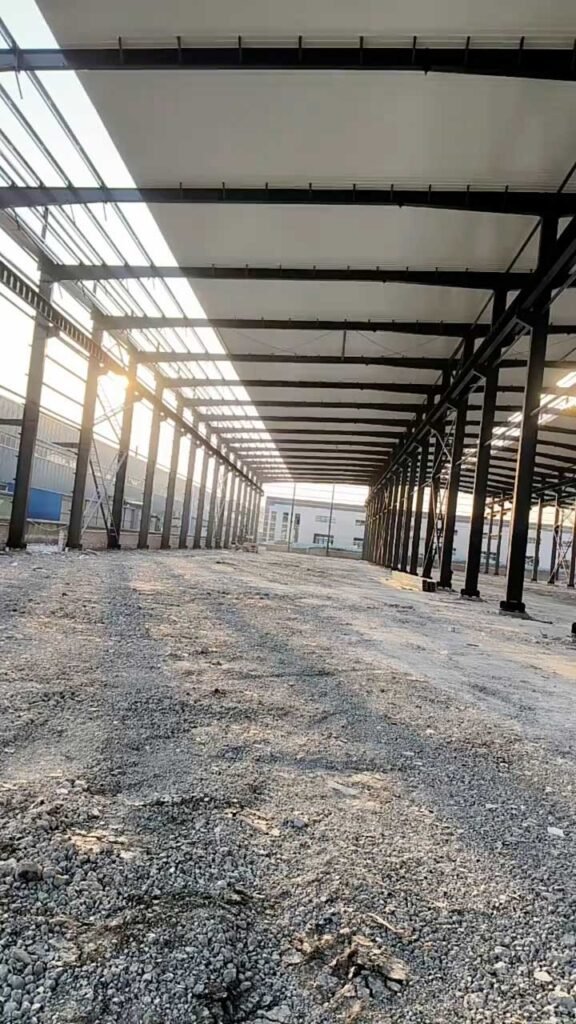
Custom Steel Structure
There is a dangerous misconception in the market that pre-engineered steel means “cookie-cutter.” If you are building a simple backyard garage, an off-the-shelf kit might suffice. But in commercial and industrial development, a one-size-fits-all approach is a recipe for operational failure.
Your business processes dictate the architecture, which is why a Custom Steel Structure is paramount.
As an integrated provider, we design the building around your specific operational flow:
Clear Span Demands: Logistics companies and aviation hangars require massive open spaces without interior columns. We routinely design custom clear spans exceeding 150 to 200 feet, utilizing tapered, built-up I-beam sections that maximize structural strength where the bending moments are highest (at the haunches) while reducing weight at the mid-span.
Heavy Crane Integration: If your facility requires overhead bridge cranes (ranging from 5-ton to 50+ ton capacities), you cannot simply bolt crane rails to a standard column. We custom-design the primary framing with stepped columns and heavy-duty crane runway beams that are engineered to handle the intense dynamic impact and braking loads of heavy machinery.
Mezzanines and Multi-Level Storage: E-commerce fulfillment centers frequently need to double their usable floor space without expanding the building footprint. We engineer custom structural steel mezzanines capable of supporting heavy racking systems, conveyor belts, and high-density foot traffic.
By customizing the structure at the engineering stage, we ensure that the building serves your business perfectly, rather than forcing your business to adapt to a generic building.
Industrial Steel Fabrication
Once the 3D model is clash-checked and approved, the digital files are sent directly to the CNC (Computer Numerical Control) machines on the factory floor. This is where the magic of modern Industrial Steel Fabrication happens.
In my early days in construction, I saw too many local fabricators relying on manual measuring, torch cutting, and hand welding. This inevitably led to human error. Today, our automated fabrication workflow guarantees millimeter precision, which translates directly to rapid, flawless erection on the job site.
The fabrication workflow follows a strict, highly controlled sequence:
CNC Cutting and Drilling: Raw steel plates are fed into high-definition plasma and laser cutters. Simultaneously, high-speed multi-spindle CNC drills bore the bolt holes into the flanges and webs. Because the machines read the exact coordinates from the 3D engineering model, the bolt holes align perfectly in the field every single time.
Automated Welding: The cut plates are assembled into H-sections and passed through automated Submerged Arc Welding (SAW) machines. This provides a continuous, deep-penetrating structural weld that is vastly superior and more consistent than manual stick welding. All welders and welding procedures are certified to American Welding Society (AWS) D1.1 standards.
Non-Destructive Testing (NDT): Quality control is not an afterthought. We utilize Ultrasonic Testing (UT) and Magnetic Particle Testing (MT) on critical moment-connection welds to ensure there are zero internal cracks or defects before the steel leaves the factory.
Surface Treatment and Coating: Bare steel rusts rapidly. Every component passes through an automated steel shot-blasting machine to remove mill scale and rust (achieving a SSPC-SP 10 Near-White metal finish). Immediately after, high-performance industrial epoxy primers and polyurethane topcoats are applied in a climate-controlled booth to guarantee long-term corrosion resistance.
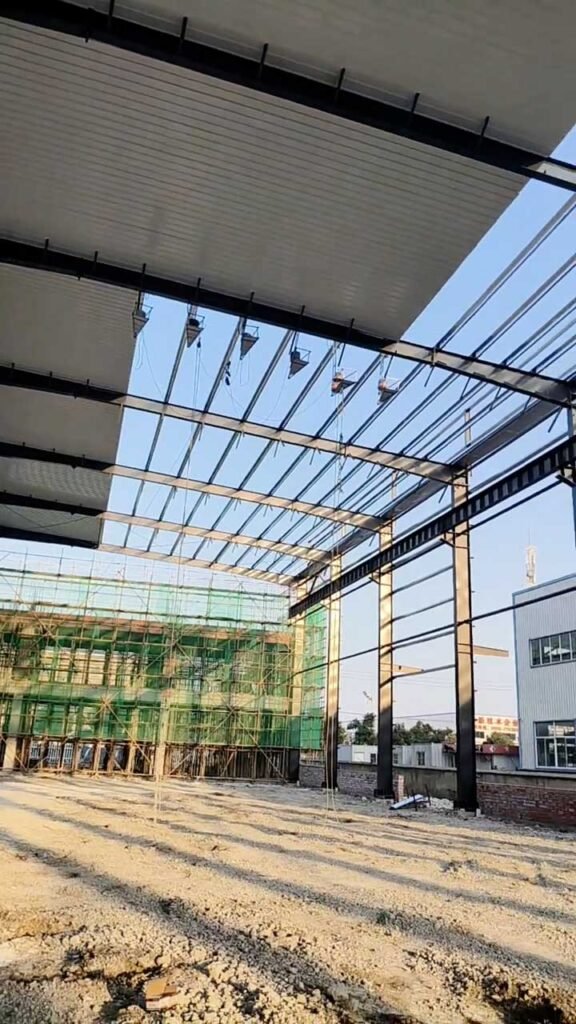
Turnkey Steel Construction Solutions
When calculating the return on investment (ROI) for heavy manufacturing or mining infrastructure, you must look at operational readiness.
Industrial facilities often require heavy modifications. If your factory needs to support 10-ton or 20-ton overhead gantry cranes, we engineer the crane runway beams and structurally reinforce the primary columns directly in the factory. Doing this level of heavy fabrication on-site in Australia would incur astronomical labor and welding fees.
By pushing the complex fabrication to our automated CNC factory in China, you lock in a fixed, low rate. Even after you pay for ocean freight and Australian import duties, the total steel building price per sqm remains drastically lower than commissioning a local Australian steel fabricator who is burdened by high local overheads.
Furthermore, thanks to the China-Australia Free Trade Agreement (ChAFTA), importing structural steel components from China can often benefit from favorable tariff treatments, provided your customs broker manages the documentation correctly. We supply all necessary compliance paperwork, including Mill Test Certificates and exact Packing Lists, to ensure smooth clearance.
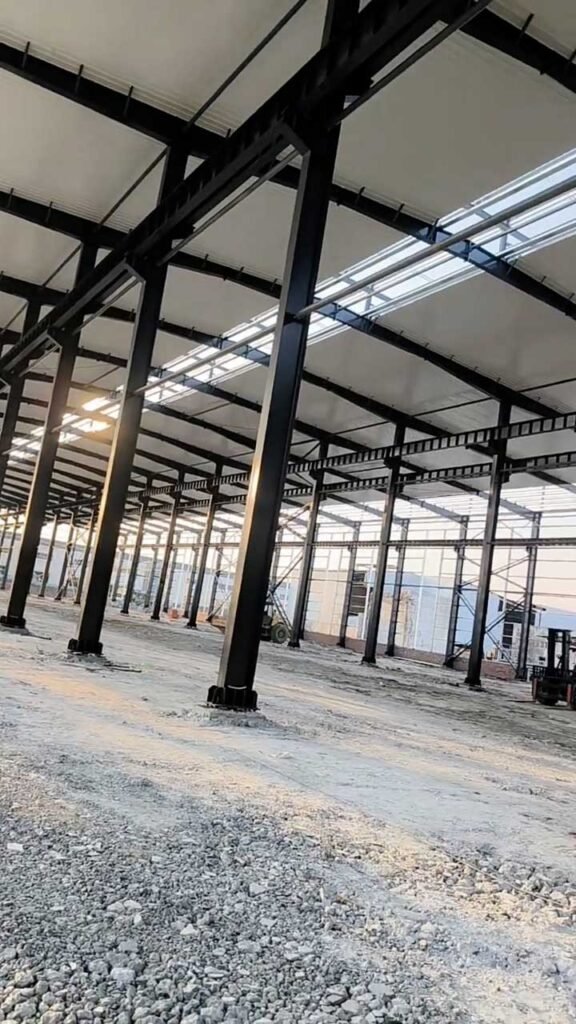
The True Cost of Fragmentation vs. Integration
To clearly illustrate why experienced U.S. builders are moving to a single-source model, review this comparison of project methodologies:
| Project Phase | Traditional Fragmented Approach | Integrated Steel Structure Design and Fabrication |
| Engineering & Detailing | Disconnected. Architect draws plans, engineer calculates loads, detailer redraws for the shop. High risk of clashes. | Unified. A single 3D Tekla model is used for engineering calculations, shop detailing, and CNC machine instructions. Zero data loss. |
| Fabrication Quality | Varies wildly depending on local shop capacity, manual labor skill, and outdoor weather conditions. | Consistent ISO-Certified Quality. Automated CNC cutting and submerged arc welding guarantee precise tolerances. |
| Field Assembly | High likelihood of field modifications. Torching new holes, grinding plates, and expensive on-site welding. | 100% Bolted Assembly. Parts fit together like a massive mechanical kit. Field labor hours are drastically reduced. |
| Project Accountability | Finger-pointing. If a beam doesn’t fit, the engineer blames the fabricator, the fabricator blames the erector. | Single-Source Liability. We design it, we fabricate it, we guarantee it fits. Period. |
Secure Your Project’s Future with Engineering Precision
In the modern U.S. construction landscape, you cannot afford to manage multiple disconnected vendors while hoping the pieces fit together on site. The risks to your timeline, your budget, and your reputation are simply too high.
By partnering with a company that masters both steel structure design and fabrication, you take back control of your project. You lock in your material costs upfront, you guarantee compliance with stringent U.S. building codes, and you ensure a smooth, rapid field erection process that gets your facility operational faster.
Stop dealing with delayed local fabrication shops and fragmented engineering plans. Our team of structural engineers and automated manufacturing specialists are ready to turn your architectural concepts into engineered reality.
Request Engineering Consultation Let’s review your site plans, local environmental loads, and operational requirements to engineer the most efficient structural framework possible.
Get a Design and Fabrication Quote Contact us today with your project dimensions and ZIP code, and receive a comprehensive, transparent proposal for a fully integrated steel structure solution delivered directly to your job site.