
Low Cost Industrial Warehouse in Peru: Prefab Steel Cost
The landscape of industrial development in Peru is evolving at an unprecedented pace. Whether you are expanding a logistics hub in Lima, establishing a new mining equipment depot in Arequipa, or building an agricultural processing facility in Piura, you already know that scaling your operational footprint is an expensive and time-consuming endeavor. For generations, traditional masonry and heavy concrete have been the local standard. However, in today’s fast-paced market, wet construction is no longer the smartest financial move for rapid, scalable expansion.
Finding a highly reliable, low cost industrial warehouse is the absolute priority for modern distribution centers and manufacturing plants. But in the construction business, “low cost” should never mean low quality. In a country like Peru, where seismic activity is a daily reality and coastal humidity constantly threatens the integrity of inferior materials, structural reliability is non-negotiable.
After spending over 20 years in the steel manufacturing and export sector, I have seen exactly what works and what fails when supplying buildings to South America. We manufacture prefabricated steel structures directly in our Chinese facilities and supply them to Peruvian enterprises, completely cutting out the local middlemen and hefty markup fees. In this guide, I am going to walk you through exactly how you can slash your capital expenditure, accelerate your project timeline, and secure a high-quality building that fully complies with the Peruvian NTE E.030 earthquake-resistant design code and the E.090 metallic structures standard.
Cheap Warehouse Building Strategies for Peruvian Enterprises
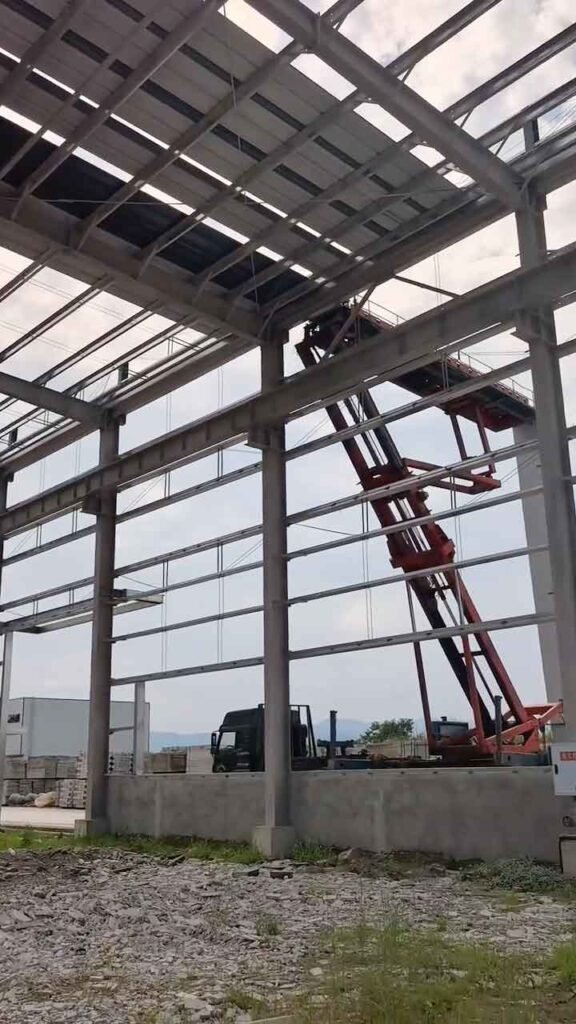
When project managers and B2B developers hear the phrase “cheap warehouse building,” they often worry about compromised safety or sub-par materials. However, achieving a cost-effective build is not about cutting corners; it is entirely about engineering efficiency and minimizing unpredictable on-site labor.
In Peru, skilled labor costs are steadily rising, and traditional block-and-mortar construction is incredibly labor-intensive. Wet construction requires extended concrete curing times, heavy machinery rentals for weeks on end, and a massive on-site workforce that drives up overhead. By shifting your project to a prefabricated steel model, you can reduce the required site labor by up to 60%. Because the components are manufactured off-site, your on-site team is strictly focused on assembly rather than raw fabrication.
Furthermore, optimizing the building’s dead weight directly impacts your foundation costs. The Peruvian coast (Zone 4) requires strict adherence to the E.030 seismic code. A heavier traditional concrete building generates significantly higher seismic base shear forces during an earthquake. To prevent collapse, these heavy buildings demand massive, highly expensive reinforced concrete foundations.
Because structural steel is highly ductile and significantly lighter than concrete, the seismic forces acting on the building are drastically reduced. This means your civil engineer can safely downsize your foundation footprint, utilizing smaller footings and less rebar. This yields massive civil works savings before the steel structure even leaves the ground, making your cheap warehouse building a reality through smart physics, not cheap materials.
Affordable Steel Warehouse Design: Managing Cost per Sqm
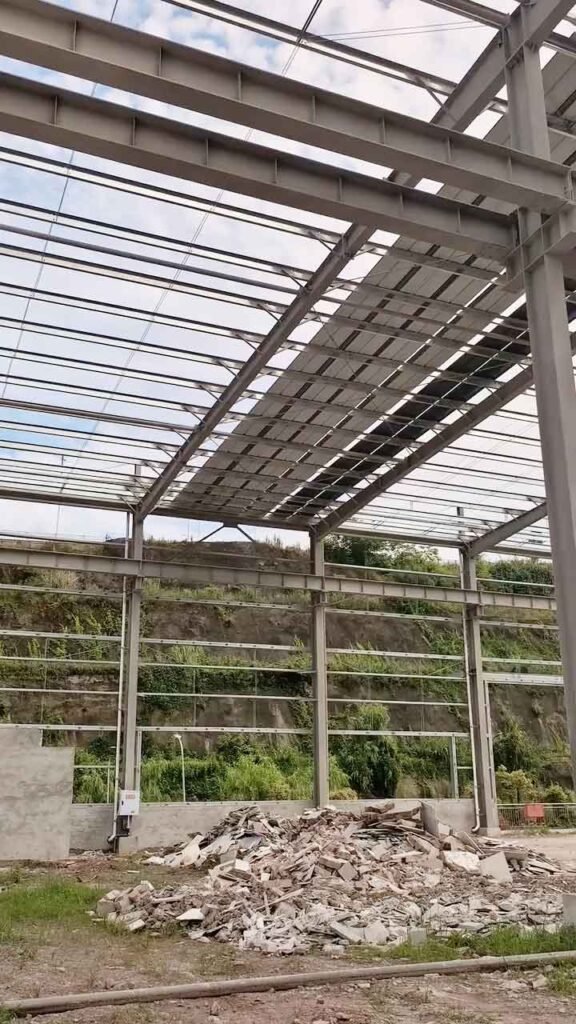
Let’s talk real numbers. If you are a B2B buyer, the only metric that truly dictates your budget approval is the cost per square meter. If you rely entirely on local steel fabrication in Lima or Trujillo, your superstructure costs can easily spiral out of control due to limited local steel mill capacity and high domestic processing costs.
An affordable steel warehouse imported directly from our manufacturing facility typically ranges between $45 to $80 USD per square meter (FOB), strictly for the steel superstructure. This includes your primary H-section columns and beams, C/Z purlins, roof cladding, wall panels, and all necessary high-strength bolts and accessories. Even when you factor in sea freight to the Port of Callao, local import taxes, customs clearance, foundation civil works, and local assembly labor, your turnkey cost remains dramatically lower than local alternatives.
Why is our cost per sqm so fiercely competitive? It comes down to massive economies of scale. Our manufacturing plants process thousands of tons of steel every single month. We utilize automated CNC drilling machines, precision laser cutting, and submerged arc welding lines. We purchase raw Q355B (equivalent to ASTM A572 Gr 50) and Q235B high-strength steel directly from the mills in bulk. We pass these factory-direct manufacturing savings directly onto your bottom line.
For a standard 2,000 sqm to 5,000 sqm logistics facility without the need for heavy overhead bridge cranes, you can expect an incredibly lightweight yet robust frame. When we design for the Peruvian Sierra (like Puno or Cusco) where snow loads and high altitudes apply, or the coast where wind dynamics are different, our structural engineers tweak the frame spacing and purlin sizes. This ensures we maintain the absolute lowest possible cost per sqm without ever violating the local structural integrity codes.
Prefab Warehouse Solution vs. Traditional Concrete in Peru
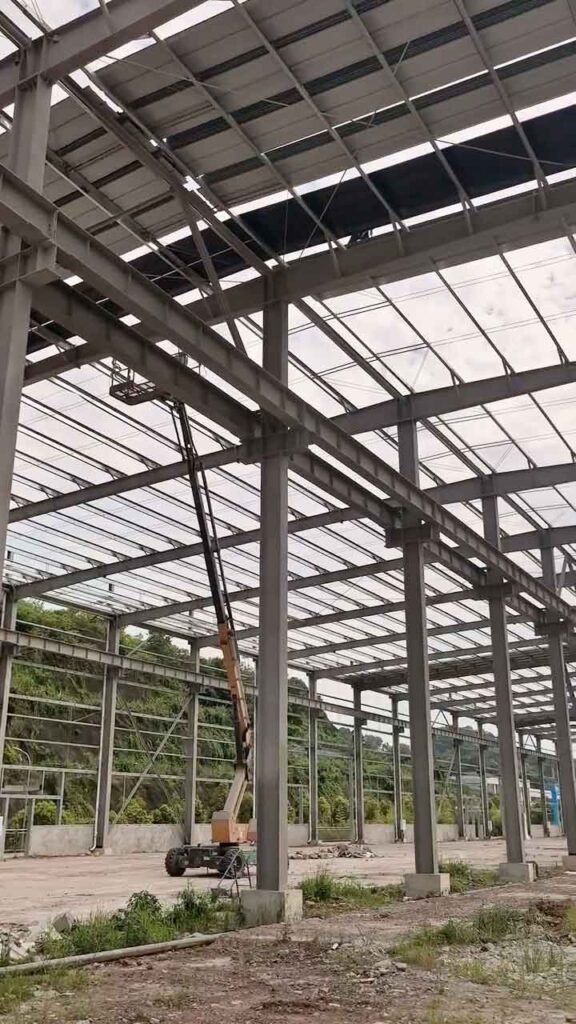
I frequently get asked by local Peruvian contractors and business owners why they should abandon the traditional brick, block, and concrete methodology they have relied on for decades. The answer becomes immediately obvious when you evaluate the project timeline and long-term flexibility. A prefab warehouse solution represents a complete paradigm shift in industrial project management.
Traditional construction in Peru is notoriously susceptible to costly delays. Unexpected rains in the highlands, supply chain hiccups for local cement, or labor strikes can halt a concrete project for weeks. Conversely, a prefab warehouse solution is manufactured in a strictly controlled factory environment. While your civil team is digging trenches and pouring the concrete foundation in Lima, your entire building is being cut, welded, painted, and packed inside our facility.
Once the shipping containers arrive at your job site, assembly is essentially a massive industrial erector set. Every single steel component is pre-punched, pre-cut, and clearly marked with a part number that corresponds to the erection drawings. Connections are bolted together using high-strength structural bolts, completely eliminating the need for extensive, highly-paid on-site welding and X-ray weld testing.
To clearly illustrate the operational advantages, look at the hard facts in this comparison:
| Project Aspect | Prefabricated Steel Warehouse | Traditional Concrete/Masonry |
| Construction Speed | 30 to 60 days for complete assembly | 4 to 8 months minimum |
| Labor Requirement | Small crew, crane operator, simple bolting | Large crew, masons, wet-trades, long duration |
| Foundation Costs | Low (lightweight structure reduces seismic load) | High (heavy structure requires deep reinforcement) |
| Clear Span Capability | Up to 40+ meters wide without interior columns | Limited, requires frequent interior support columns |
| Seismic Performance | Excellent ductility (fully compliant with E.030) | Rigid, prone to cracking under high seismic stress |
| Future Expansion | Easy to unbolt end-walls and extend the bay | Very difficult, messy, and expensive to modify |
| Cost Predictability | Fixed factory price, zero material waste on site | High risk of budget overruns and material theft |
Warehouse Cost Reduction from Manufacturing to Assembly
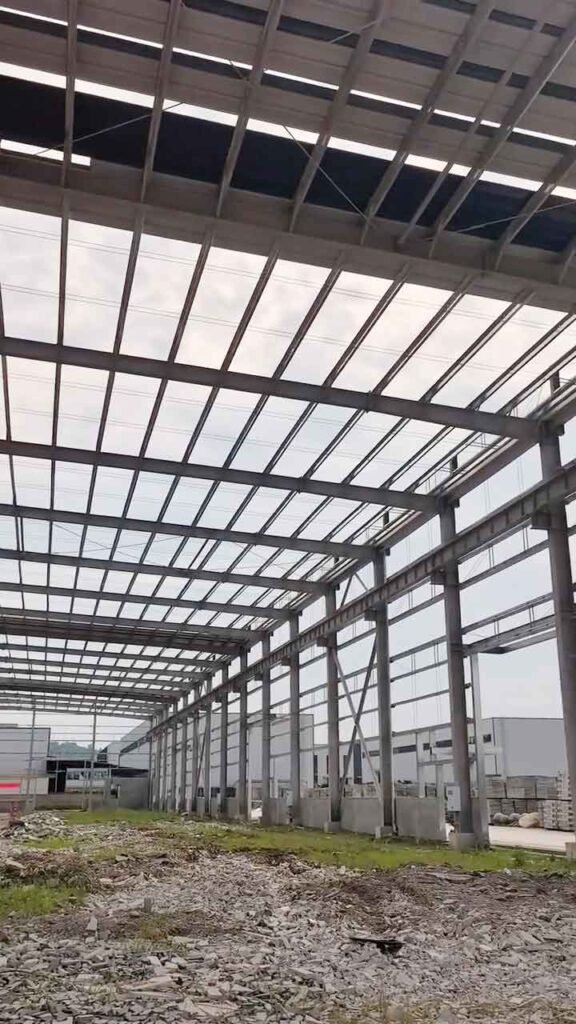
Achieving maximum warehouse cost reduction requires a holistic, end-to-end approach. It is not just about hunting for the cheapest steel on the market; it is about systematically eliminating waste and mitigating future maintenance at every phase of the building’s lifecycle.
First, we eliminate material waste. In traditional builds, it is common to see up to 10% of raw materials wasted, cut incorrectly, or damaged on-site. With our pre-engineered buildings, the steel framework is optimized using advanced 3D CAD software like Tekla Structures. We engineer the exact amount of steel required to meet load-bearing limits—no more, no less. Zero waste on the factory floor translates to zero wasted budget for you.
Second, consider the localized environmental threats. For coastal logistics hubs in Callao, Trujillo, or Piura, heavy salt spray and high atmospheric humidity significantly accelerate rust and corrosion. To combat this, we utilize hot-dip galvanized steel framing or apply heavy-duty epoxy zinc-rich primers finished with marine-grade polyurethane topcoats. This drastically reduces long-term maintenance requirements, representing a massive warehouse cost reduction over a 20-to-30-year operational lifespan.
Third, operational energy efficiency cannot be ignored. If you are operating a temperature-sensitive storage facility or a manufacturing plant with workers inside, heat management is critical. By integrating insulated sandwich panels (featuring EPS, Rockwool, or Polyurethane cores) for your roof and exterior walls, we drastically reduce thermal transfer. This keeps your warehouse naturally cooler during the harsh summer months and protects sensitive inventory, which directly lowers your ongoing HVAC and electrical overhead.
Importing Your Industrial Storage Building Directly from China to Callao
Many B2B buyers hesitate to source internationally because they assume importing an industrial storage building from China is a massive logistical headache. Let me assure you, with two decades of export experience, the shipping corridor between China and Peru is one of the most reliable and streamlined maritime routes in the world.
Once your architectural design is finalized and the steel is fabricated, the building components are carefully nested and loaded into 40ft Open Top (OT) or 40ft High Cube (HQ) shipping containers. Our loading teams use proprietary packing software to maximize container space, ensuring you aren’t paying to ship empty air, which lowers your overall freight cost per ton. The transit time from major Chinese ports—such as Qingdao, Tianjin, or Shanghai—directly to the Port of Callao is typically around 30 to 35 days.
We provide a complete, flawless set of documentation for your local customs broker. This includes the Bill of Lading, Commercial Invoice, detailed Packing List, and the Certificate of Origin. Crucially, the Certificate of Origin allows you to take advantage of the China-Peru Free Trade Agreement (FTA), which can significantly reduce or entirely eliminate import tariffs on structural steel products.
By purchasing your industrial storage building direct from the manufacturer, you completely bypass local Peruvian distributors who simply import the same structures and mark up the prices by 30% to 50%. Upon delivery, you receive highly detailed 3D erection drawings and node blueprints. Any local Peruvian assembly crew or general contractor with basic crane rigging experience can follow our structural blueprints to erect the building safely, correctly, and rapidly.
Long-term savings begin the exact day you decide to source smartly. You are not just buying tons of steel; you are buying speed to market, engineering precision, and a massive competitive advantage for your commercial operations.
Expanding your logistics network, agricultural storage capacity, or manufacturing base in Peru should not drain your working capital. By leveraging Chinese manufacturing efficiency, rigorous compliance with Peruvian seismic engineering standards, and highly optimized maritime logistics, you can erect a world-class facility at a fraction of the local cost.
If you are ready to stop overpaying for slow, traditional concrete construction and want to explore a smarter, faster, and much more resilient structural solution, our engineering team is ready to analyze your site plans.
Request Your Free Warehouse Cost Estimate today, or contact us directly to Get a Custom Warehouse Proposal tailored specifically to your exact location, wind loads, and operational requirements.