
Fast Installation Steel Warehouse Supplier for Chile
In Chile’s hyper-competitive industrial sector, time is the ultimate currency. Whether you are expanding a heavy equipment depot for the copper mining operations in Antofagasta or rapidly scaling a cold storage agro-export facility in the O’Higgins region, the pressure to become operational is intense.
However, after spending over a decade navigating the Chilean construction landscape—coordinating with local engineering firms, managing site crews, and dealing with local steel supply chains—I know exactly where projects bleed money. Relying on local steel fabricators or traditional heavy concrete often leads to devastating delays. Local mills face frequent backlogs, skilled on-site welders charge premium rates, and winter weather completely halts wet construction.
The modern solution for Chilean developers is bypassing local fabrication entirely. By importing a fast installation steel warehouse directly from our specialized manufacturing facility in China, developers are slashing project timelines by up to 50% while securing a superior, code-compliant asset.
In this guide, I will explain how our engineered-for-export structures overcome Chile’s toughest logistical and seismic challenges, dramatically reducing your on-site downtime and labor costs.
Engineering a Compliant Quick Build Warehouse
A common—and dangerous—misconception is that a “quick build” implies a generic, off-the-shelf shed. In Chile, generic buildings collapse.
Designing a Quick Build Warehouse for the Chilean landscape requires absolute engineering precision. The country sits on the Ring of Fire, and the Ministry of Housing and Urban Development (MINVU) enforces some of the strictest structural codes on the planet. Recently, the regulatory landscape shifted with the approval of NCh2369:2025, the updated official standard specifically governing the seismic design of industrial structures and facilities (replacing the decades-old NCh2369:2003).
When we design your structure, our engineering team does not guess. We utilize 3D Tekla Structures to model the exact seismic demands required by NCh433 (for general building loads) and the newly enforced NCh2369:2025 (for industrial heavy loads, overhead cranes, and equipment anchorage).
Because the entire building is modeled dynamically before a single piece of steel is cut, the fabrication process in our Chinese facility is flawless. We utilize automated CNC machinery to pre-cut, pre-drill, and weld high-yield steel (such as Q355B, equivalent to ASTM A572 Gr 50). By doing the heavy engineering and fabrication in a controlled factory environment, we deliver a customized, highly ductile steel frame that is ready for immediate, safe assembly the moment it clears Chilean customs.
The Economics of Rapid Warehouse Construction
When we ship containers into the Port of San Antonio or Valparaíso, the real financial advantage for the Chilean developer begins on the job site.
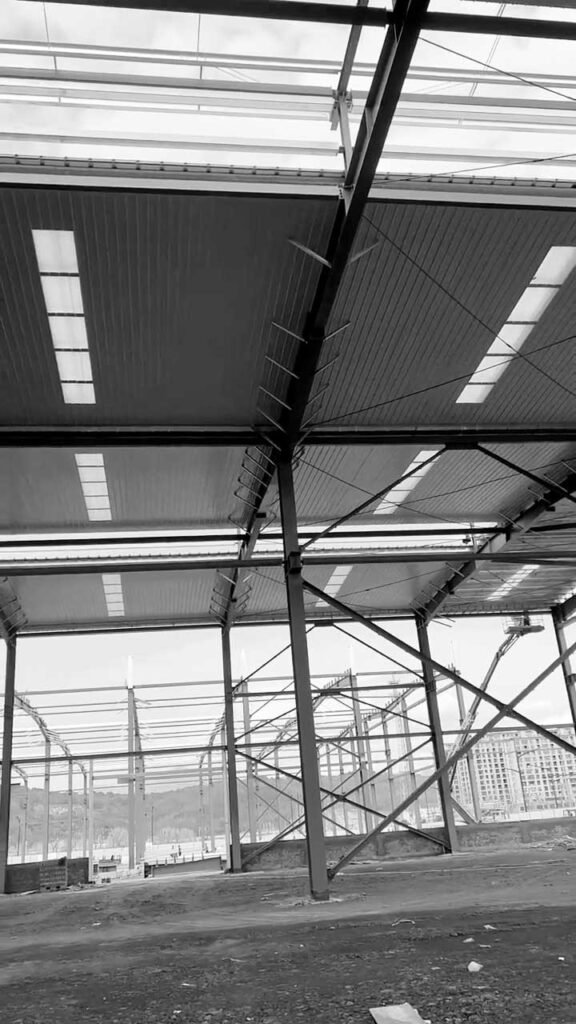
The core philosophy of Rapid Warehouse Construction is the elimination of field fabrication. Traditional construction in Chile involves flatbed trucks dumping raw steel beams on your site. Your local contractor then spends weeks manually measuring, cutting, grinding, and welding the steel together. This requires hiring expensive, specialized welders, requires continuous X-ray testing of field welds, and leaves your timeline highly vulnerable to weather delays.
Our system is entirely different. We deliver a massive mechanical kit.
Every primary column, rafter, and purlin arrives clearly stamped with a part number matching your detailed erection blueprints.
All bolt holes are pre-punched by CNC lasers at the factory.
Zero field welding is required.
Your local Chilean rigging crew simply uses a mobile crane to lift the members and pneumatic impact wrenches to secure the high-strength structural bolts. This bolted-assembly approach reduces required on-site labor hours by up to 60%. Not only do you save a fortune on contractor hourly rates, but your site safety improves drastically by eliminating hot-work (welding torches) and the associated fire risks.
Traditional vs. Imported Prefabricated Steel Warehouse
To truly understand how importing a structure protects your capital expenditure in Chile, you must compare it directly against the local alternatives.
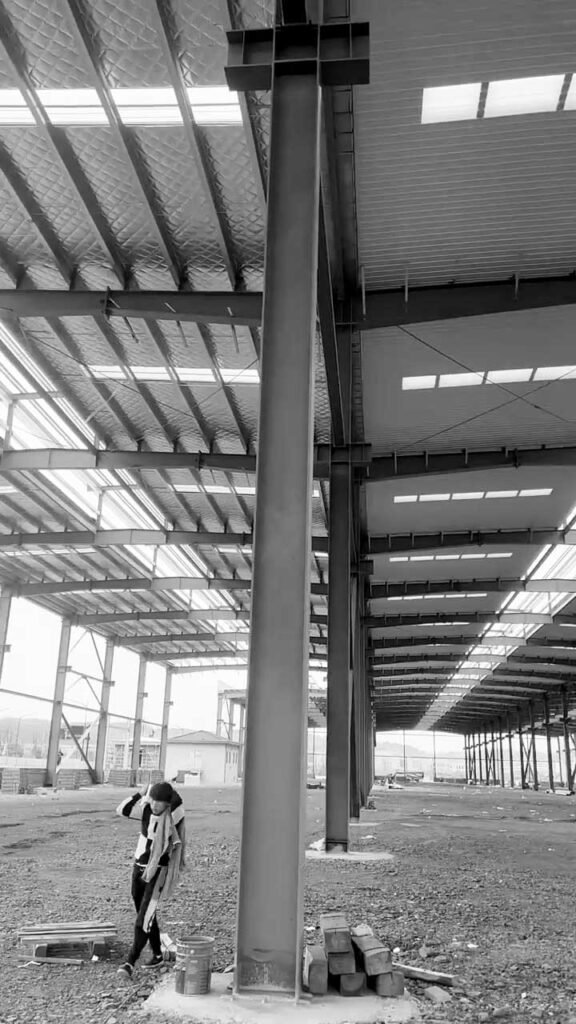
Here is what 10 years of site data reveals when comparing traditional Chilean construction methods with an imported Prefabricated Steel Warehouse:
| Construction Factor | Traditional Concrete / Local Steel Welding | Imported Prefabricated Steel Warehouse |
| Seismic Compliance | Concrete requires massive, expensive shear walls; local steel requires costly field-weld testing. | Factory-engineered ductility fully complies with NCh433 and NCh2369:2025. |
| Site Labor Requirements | Very High. Requires large teams of masons, carpenters, and specialized structural welders. | Low. Assembled rapidly by a small rigging crew using cranes and impact wrenches. |
| Project Timeline | 8 to 12 months. Highly susceptible to rain delays and local material shortages. | 3 to 4 months. Factory manufacturing runs parallel to your local civil foundation work. |
| Clear Span Capacity | Limited. Frequently requires intrusive interior columns that disrupt forklift logistics. | Massive. Capable of 40 to 60-meter clear spans for unobstructed interior operations. |
| Material Cost Control | Unpredictable. Exposed to local Chilean inflation and extreme material waste (up to 15%). | Fixed Factory Price. You lock in your superstructure costs upfront with zero on-site material waste. |
Executing a Fast Track Industrial Building
If you are developing a distribution center near Santiago or a packing facility along Route 5 (Ruta 5 Sur), every week your project is delayed represents lost revenue.
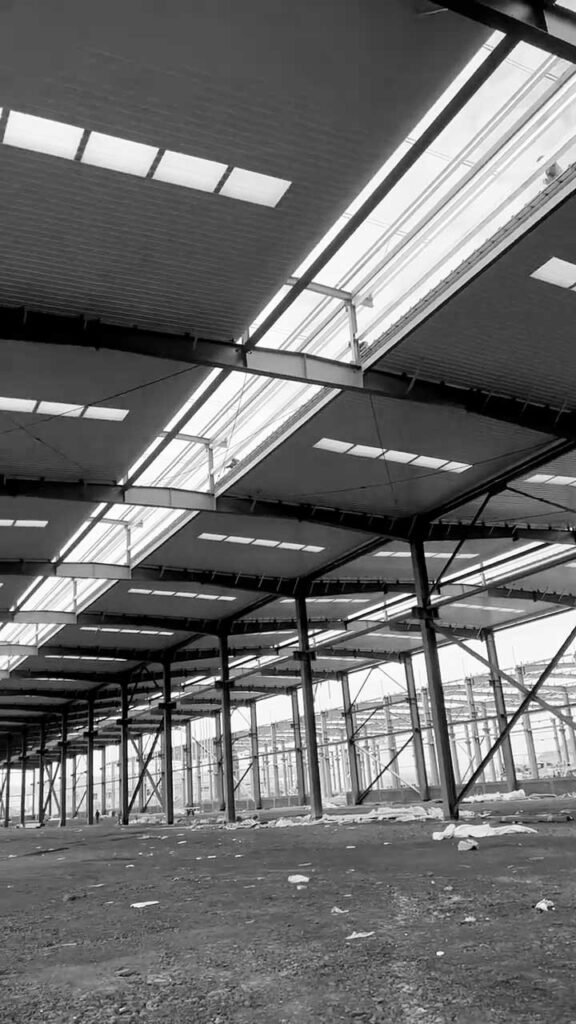
A Fast Track Industrial Building is not achieved by rushing the builders; it is achieved through overlapping project phases—a concept known as parallel processing.
When you source your steel locally in Chile, the process is painfully linear. Your civil engineers must pour the foundation and wait for it to cure before the local fabricator can take final field measurements and begin cutting steel.
By importing from our facility, we sever that dependency. The moment you approve our structural engineering drawings, two things happen simultaneously:
In Chile: Your local civil contractor begins earthworks, trenching, and pouring the concrete foundation footings.
In China: Our automated factory begins cutting, welding, and painting your steel frame.
While your concrete is curing in the Chilean sun, your building is crossing the Pacific Ocean. By the time your foundation is ready to bear weight, the shipping containers are arriving on site. The superstructure goes up immediately. This parallel workflow routinely shaves months off the standard construction calendar, allowing your business to transition from expenditure to revenue generation at unprecedented speeds.
Future-Proofing with a Modular Warehouse Building
The Chilean economy is dynamic. A logistics footprint that works for your supply chain today might be completely inadequate in three years. Traditional block or concrete tilt-up buildings are static; expanding them requires destructive, dusty, and expensive demolition that halts your current operations.
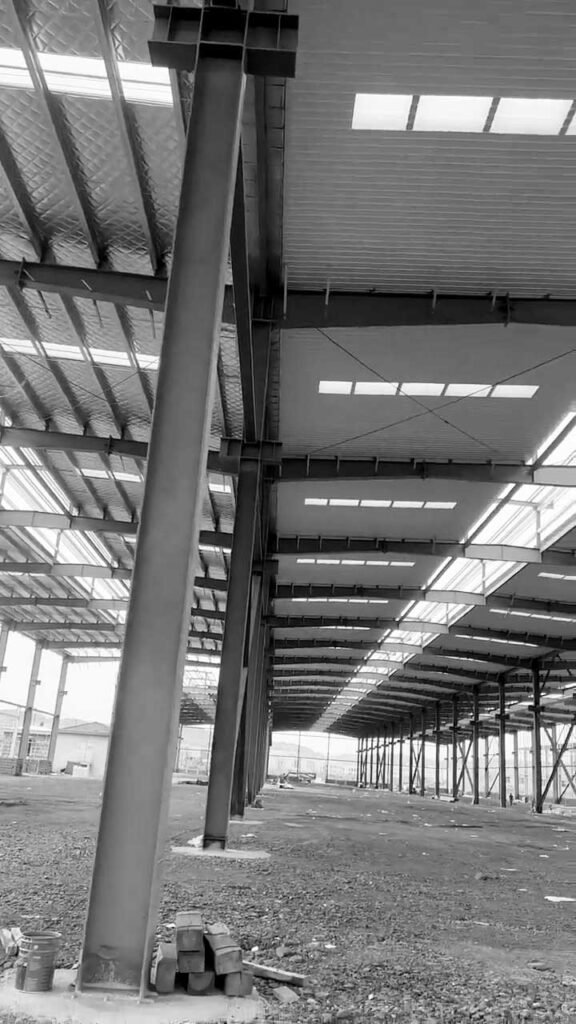
The ultimate advantage of our steel system is that it functions as a highly scalable Modular Warehouse Building. We engineer our structures using rigid frame bays (typically spaced 6 to 8 meters apart). If you need to double your square footage in the future, the process is seamless:
You simply remove the metal cladding from the end-wall.
Erect new steel bays seamlessly bolting into the existing primary frame.
Extend the roofline and re-attach the cladding.
Because the system is modular, your daily operations inside the existing warehouse can continue entirely uninterrupted while the expansion takes place outside.
For specialized industries, this modularity extends to the building envelope. Whether you need heavy-duty insulated sandwich panels (PIR or PUR) to maintain cold-storage temperatures for the fruit export market, or integrated crane runway beams for a mining maintenance workshop, the modules are customized at the factory to support your exact operational load.
Secure Your Logistics Infrastructure Today
In the Chilean industrial market, relying on fragmented local construction methods is a massive financial risk. You do not have to accept slow build times, unpredictable labor costs, or the uncertainty of local steel availability.
By partnering directly with a world-class structural manufacturer, you gain access to precision engineering, strict adherence to the latest Chilean seismic standards, and a delivery model built purely for speed and operational efficiency.
Stop letting local supply chain bottlenecks dictate your expansion. Our engineering team is ready to review your architectural plans, assess your local wind and snow loads, and deliver a structural package that your local team can erect flawlessly.
[Get a Fast Delivery Warehouse Quote] Contact us today with your project dimensions and location in Chile. We will provide a comprehensive, transparent proposal to engineer, manufacture, and ship your next industrial facility directly to your site.