
Heavy Duty Warehouse Steel Structure in Canada
Forging Resilience: The Canadian Builder’s Guide to Heavy Duty Warehouse Steel Structures
If you have spent the last decade managing commercial and industrial construction sites across Canada, from the oil sands of Fort McMurray to the manufacturing hubs of Mississauga, you already know the brutal reality of our environment. Building in Canada is not for the faint of heart. We deal with crippling snow loads, aggressive freeze-thaw cycles, and heavy industrial operations that demand unyielding structural integrity.
When you are commissioned to build a facility that needs to house 50-ton overhead bridge cranes or support meters of dense, wet snow on the roof, standard commercial steel simply will not cut it. You need a heavy duty warehouse steel structure.
However, sourcing high-capacity structural steel locally in Canada right now is a logistical and financial nightmare. Local fabrication shops are facing massive labor shortages, and domestic steel prices have skyrocketed. The lead times for a heavy industrial frame can easily push your project into the winter months, halting foundation work and killing your cash flow.
The most successful developers and EPC (Engineering, Procurement, and Construction) firms in Canada have pivoted. As a leading Chinese steel structure manufacturer with extensive export experience to North America, we supply complete, pre-engineered heavy-duty steel buildings directly to Canadian job sites. Crucially, our manufacturing facilities hold the gold standard for the Canadian market: CWB (Canadian Welding Bureau) Certification.
In this comprehensive guide, I will break down exactly how we engineer, fabricate, and export high-load structural steel that perfectly satisfies the National Building Code of Canada (NBCC), drastically reduces your procurement costs, and guarantees decades of operational safety.
Climate-Resilient Heavy Industrial Warehouse Solutions
In the Canadian industrial sector—whether it is a mining maintenance facility in Sudbury or a forestry mill in British Columbia—the building is essentially a massive piece of heavy equipment. A Climate-Resilient Heavy Industrial Warehouse must be designed to withstand severe external environmental loads while simultaneously supporting extreme internal operational demands.
The first step in our engineering process is aligning perfectly with the National Building Code of Canada (NBCC) and local provincial amendments (like the OBC or ABC). We do not use generic, off-the-shelf blueprints. Every structure is mathematically modeled for its exact postal code.
Using advanced 3D detailing software like Tekla Structures, our engineering team maps out the structural envelope. We specify high-strength steel grades—such as Q355B or Q355D, which are the direct metallurgical and mechanical equivalents to Canada’s CSA G40.21 350W steel. This high-yield steel forms the backbone of the primary rigid frames (columns and rafters), allowing the building to absorb massive environmental stresses without permanent deflection or catastrophic failure.
Because we process thousands of tons of this heavy-grade steel monthly in our automated Chinese facilities, we bypass the supply chain bottlenecks plaguing the Canadian domestic market, delivering a superior heavy-duty product at a fraction of the local cost.
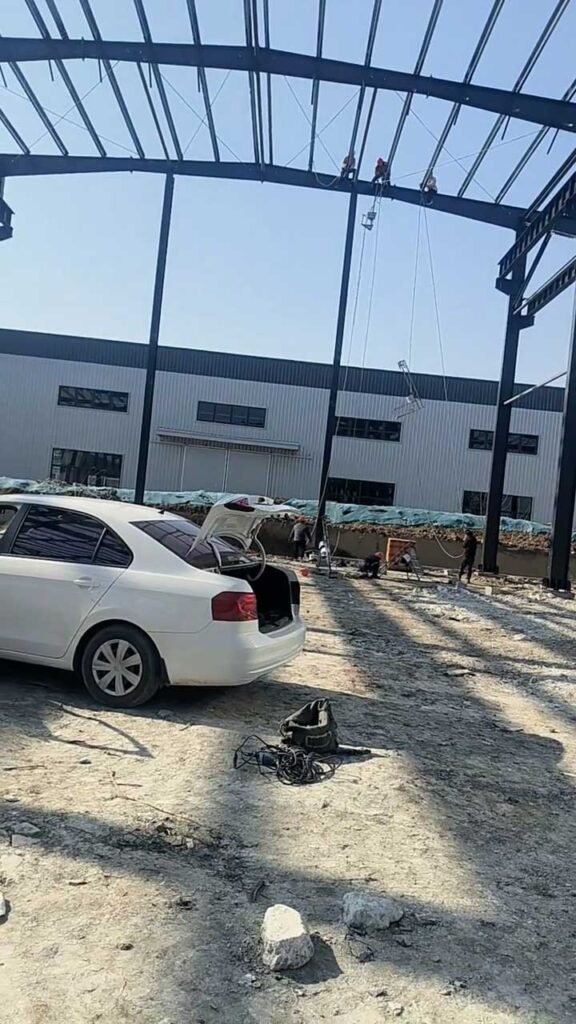
Precision-Engineered High Load Steel Structure for Extreme Snow
Perhaps the greatest threat to any wide-span building in Canada is winter. The roof of your warehouse is essentially a massive shelf collecting dead weight for five to six months of the year.
Designing a Precision-Engineered High Load Steel Structure requires a deep understanding of NBCC snow load calculations, specifically distinguishing between ground snow load (Ss) and the associated rain load (Sr). A building in coastal Halifax faces dense, wet snow and ice buildup, whereas a facility in the Prairies deals with wind-driven snow drifts that create unbalanced loading on the roof.
To combat these crushing high load requirements, our structural engineers implement several critical design strategies:
Reduced Purlin Spacing: Standard warehouses might space roof purlins at 1.5 meters. For heavy snow load zones, we tighten this spacing significantly and upgrade to heavy-gauge, cold-formed Z-purlins.
Increased Roof Pitch: We optimize the roof pitch to encourage natural snow shedding, preventing the accumulation of massive ice dams at the eaves.
Reinforced Portal Frames: The primary rafters are designed as tapered, built-up welded sections. We drastically increase the web depth and flange thickness at the haunches (the knee joints where the roof meets the column) to handle the massive bending moments generated by a roof supporting hundreds of tons of snow.
Asymmetrical Drift Loads: If your heavy duty warehouse steel structure has varying roof heights, parapets, or sits adjacent to a taller existing building, we engineer the frame to support the asymmetrical snow drift loads that accumulate in these architectural “valleys.”
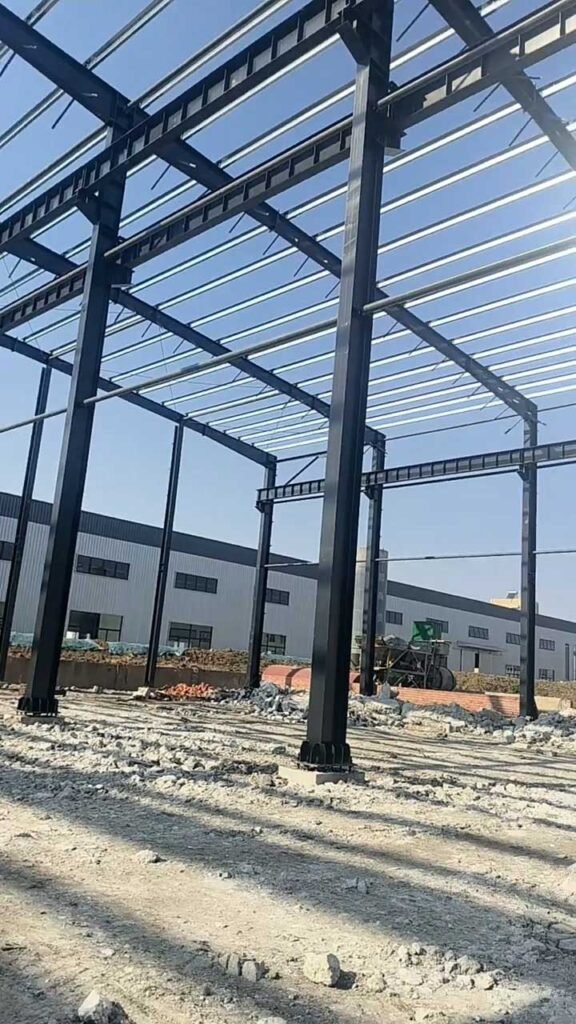
Crane-Ready Heavy-Duty Industrial Steel Frame
In heavy manufacturing, steel processing, or heavy equipment maintenance, forklifts are insufficient. You need heavy-duty overhead bridge cranes running the entire length of your facility.
Integrating heavy crane systems changes the entire physics of the building. You cannot simply bolt a crane rail to a standard column. A Crane-Ready Heavy-Duty Industrial Steel Frame must be engineered to absorb dynamic forces—not just the static dead weight of the load being lifted, but the severe lateral and longitudinal braking forces generated when a 50-ton loaded crane suddenly stops.
Our heavy-duty crane building designs feature:
Stepped Columns: For cranes exceeding 10 tons, we utilize stepped columns. The lower portion of the column is massively widened. The inner flange directly supports the heavy crane runway beam, transferring the crushing vertical load directly down to the foundation, while the outer flange continues upward to support the roof.
Heavy Crane Runway Beams: We fabricate specialized, deep I-beams with heavy top flanges (often reinforced with channel sections) to resist the lateral thrust of the crane wheels.
Longitudinal Bracing: To prevent the entire warehouse from swaying along its length when the crane brakes, we implement aggressive heavy-angle cross-bracing and robust portal bracing between the structural bays.
Because we pre-weld all heavy crane corbels and structural brackets in our factory, your Canadian erectors simply need to bolt the runway beams into place. The precision is millimeter-perfect, ensuring your crane rails run dead straight and eliminating premature wear on your crane wheel flanges.
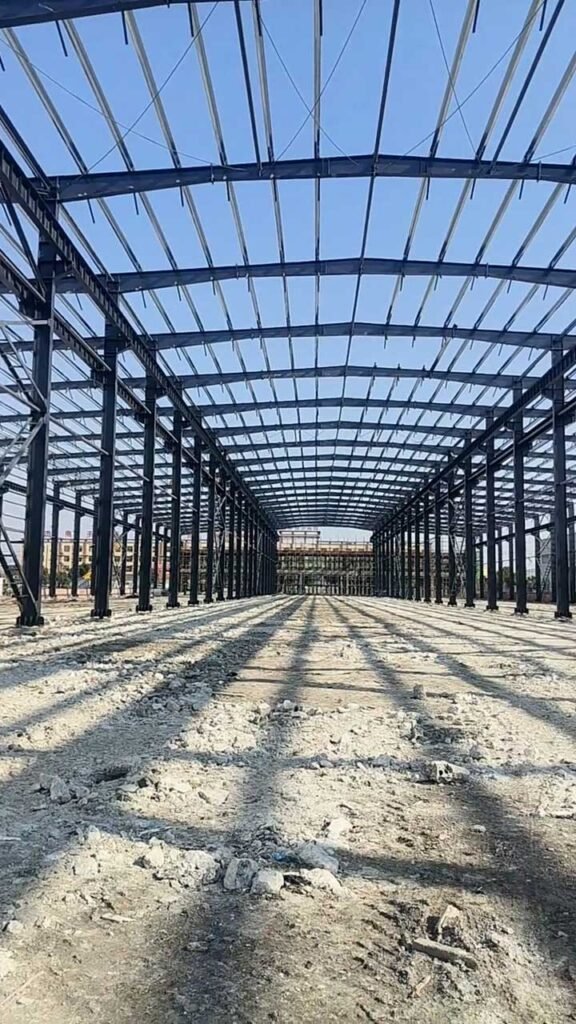
NBCC-Compliant Reinforced Warehouse Building Standards
The primary concern of any Canadian developer looking to import structural steel is compliance. “Will the local building inspector sign off on this?” The answer is unequivocally yes, provided you partner with a manufacturer that holds the correct certifications.
For a NBCC-Compliant Reinforced Warehouse Building, weld quality is everything. The Canadian standard for structural welding is extremely stringent. Our fabrication facility holds the highly coveted CWB (Canadian Welding Bureau) Certification to CSA W47.1.
This means that our automated Submerged Arc Welding (SAW) machines, our manual welders, and our internal Quality Control procedures are independently audited and certified to Canadian standards. When your steel arrives at the Port of Vancouver or Montreal, it is accompanied by an airtight paper trail:
CWB Welding Certificates: Proving all structural welds meet CSA W59 standards.
Mill Test Certificates (MTCs): Detailing the chemical composition and yield strength of every batch of steel used in your project.
Non-Destructive Testing (NDT) Reports: Ultrasonic (UT) and Magnetic Particle (MT) test results for full-penetration butt welds on your primary moment connections.
We provide your local Canadian structural Engineer of Record (EOR) with all the necessary documentation, Tekla models, and material certs required to confidently issue the final structural sign-off (Schedules B and C in BC, or equivalent provincial forms).
Long-Lasting Durable Warehouse Construction and ROI
When you invest in heavy industrial infrastructure, you are thinking in decades, not years. A Long-Lasting Durable Warehouse Construction protects your capital expenditure by driving down ongoing maintenance costs.
To combat Canada’s harsh environment and the heavy use of road salts that get tracked into industrial facilities, we utilize commercial-grade anti-corrosion treatments. All heavy steel components are blasted to a near-white metal finish (SA2.5) and coated with heavy-duty zinc-rich epoxy primers and polyurethane topcoats. We also supply premium insulated metal panels (polyurethane or mineral wool core) to ensure your building envelope is highly thermally efficient, slashing your winter heating bills.
To clearly illustrate why Canadian builders are abandoning local procurement for imported heavy-duty structures, look at this direct comparison based on current market realities:
Local Canadian Steel vs. Imported Chinese CWB-Certified Steel
| Project Metric | Sourced from Local Canadian Fabricator | Imported from our CWB-Certified Facility |
| Material Costs | Extremely High. Domestic steel prices include massive local labor markups. | Highly Competitive. Leverage our massive raw material purchasing power and automated efficiency. |
| Welding Compliance | CWB Certified (Local). | CWB Certified (International). Fully compliant with CSA W47.1 and W59. |
| Delivery Timeline | 6 to 10 months. Local shops are backlogged; winter weather delays field work. | 3 to 4 months. Factory fabrication runs parallel to your Canadian site foundation work. |
| Crane Integration | Requires expensive custom field measurements and slow local fabrication. | Precision Engineered. Heavy crane columns and runway beams arrive fully integrated and ready to bolt. |
| Assembly Method | Often requires on-site welding modifications and grinding by expensive local trades. | 100% Bolted Connection. High-strength ASTM A325/A490 equivalent bolts. Zero field welding required. |
| Structural Documentation | Standard local MTCs provided. | Comprehensive Export Package. Full MTCs, CWB docs, NDT reports, and detailed 3D erection drawings. |
Secure Your Heavy Industrial Project Today
In the high-stakes world of Canadian industrial construction, you cannot afford to compromise on structural durability, nor can you afford to let local supply chain bottlenecks dictate your project schedule.
By partnering directly with a top-tier Chinese manufacturer, you are not just buying a building; you are securing a heavy duty warehouse steel structure engineered to conquer crushing snow loads, support massive dynamic crane forces, and sail through local Canadian building inspections via our CWB certification.
Stop waiting on local backlogs and stop overpaying for heavy steel. Our engineering team is ready to review your architectural plans, calculate your precise NBCC environmental loads, and deliver a structural package that your local team can erect safely, rapidly, and profitably.
Request a Structural Design Consultation Contact us today with your project dimensions, specific postal code, and overhead crane requirements. We will provide you with a comprehensive, code-compliant preliminary design and a factory-direct pricing proposal tailored exclusively for the Canadian industrial market.